
Company News
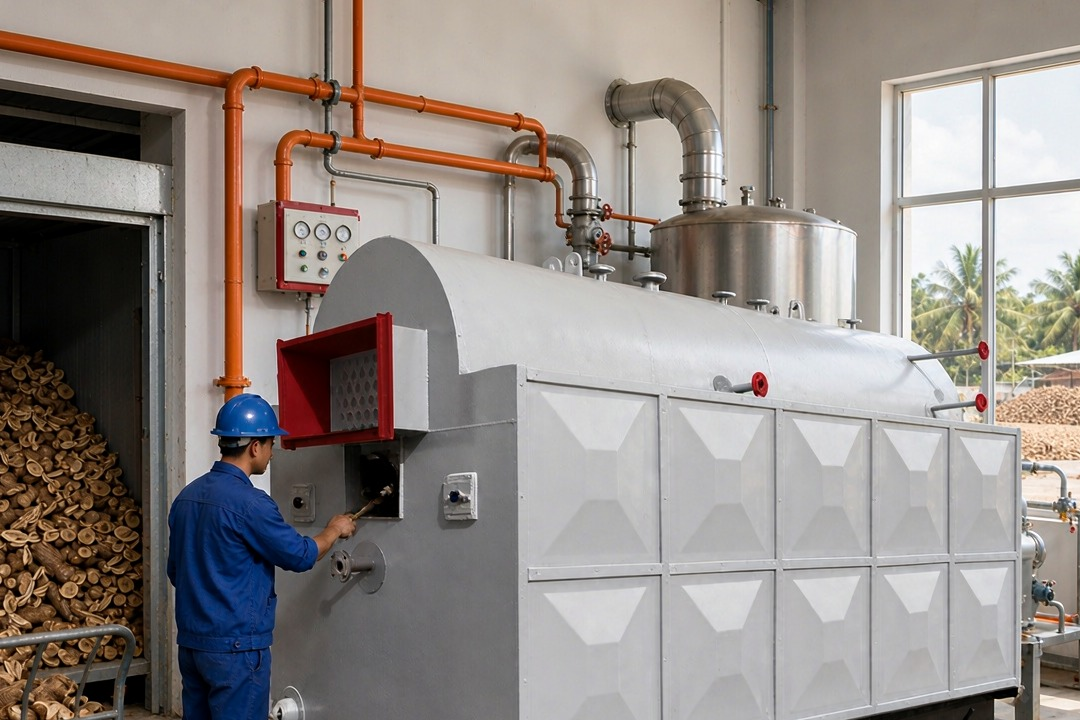
A copra mill is one of the few factories where the fuel for the process grows around the building. Coconuts are split, the kernel is dried down to copra at 6 to 7 percent moisture, and the shell is left in a heap behind the yard. That heap is a real fuel: about one tonne of shell for every tonne of copra in a typical small mill, a heating value close to good firewood, low ash and almost no sulphur. The same mill also needs saturated steam at half a dozen points, from the cooker in front of the expellers to the vacuum deodorizer in the refining house.
Many small and medium mills still burn shell in a brick furnace under an open cooker. The arrangement works after a fashion, but the heat is uncontrolled, the flue gas leaves black, and the refining section has no steam at all, so bleaching and deodorization are either outsourced or done with electric heaters that cost far more per tonne of oil. A proper steam boiler turns the same shell heap into a metered utility: steam at a steady pressure, dry enough for direct contact with edible oil, and a flue gas that can be cleaned before it leaves the stack.
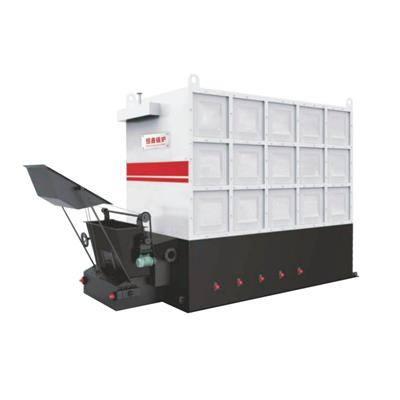
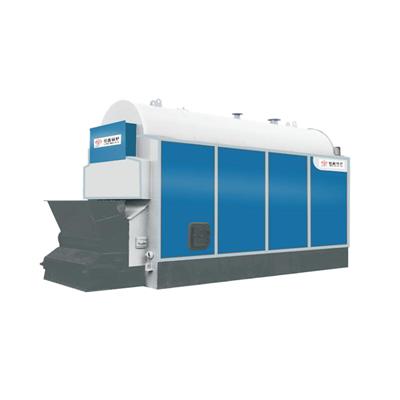
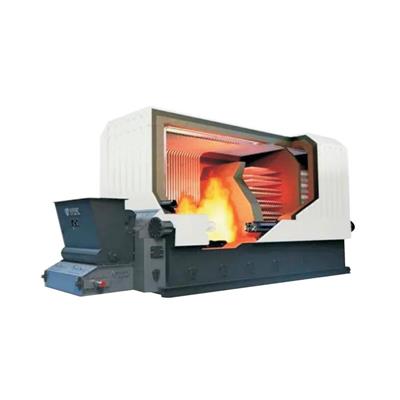
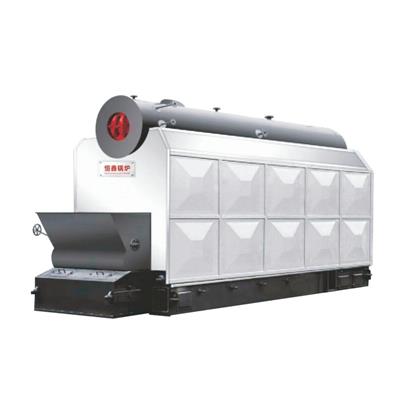
The DZH manually fired biomass steam boiler is built for this scale of plant. It is a horizontal three pass unit with a fixed step grate, hand stoking and a rated output from 0.5 to 6 tonnes of steam per hour at 1.25 MPa. It suits a mill where shell is free, labour is available, the load follows a single or double shift, and the capital budget is small enough that a fully automatic boiler cannot be justified.
Steam demand in a coconut oil mill is not one large load but a set of small ones at different pressures and different times. The table below gives planning values collected from mills in South and Southeast Asia. Local practice varies, and a mill that sells crude oil only will skip the refining rows entirely.
| Steam user | Pressure at the user (MPa) | Process temperature (degrees C) | Steam demand |
|---|---|---|---|
| Copra cooker and conditioner before pressing | 0.3 to 0.5 | 90 to 110 | 80 to 120 kg per tonne of copra |
| Expeller barrel and choke heating | 0.4 to 0.5 | 90 to 100 | 15 to 25 kg per tonne of copra |
| Crude oil settling and storage coils | 0.3 | 60 to 70 | 20 to 30 kg per tonne of oil |
| Degumming and neutralization heating | 0.3 to 0.4 | 70 to 85 | 25 to 40 kg per tonne of oil |
| Bleaching and clay heating | 0.3 | 90 to 110 | 15 to 25 kg per tonne of oil |
| Deodorizer stripping steam, direct injection | 0.3 to 0.5 | 180 to 230 oil temperature under vacuum | 20 to 40 kg per tonne of oil |
| Feedwater deaeration | 0.02 to 0.05 | 104 to 110 | 20 to 30 kg per tonne of steam |
| Washdown, canteen and laboratory | 0.3 | Not critical | 10 to 20 kg per hour |
Two features of this load shape decide the boiler selection. The first is that cooking and expeller heating run continuously while the press line runs, whereas deodorization is a batch step that draws a large flow for two to four hours and then stops. The second is that every user sits below 0.6 MPa, so a 1.25 MPa boiler leaves a wide margin at the reducing station, keeps the distribution mains dry and gives useful flash steam at the trap stations. Most of these duties fall under food and beverage processing, where steam quality and documentation matter as much as pressure.
Coconut shell is not a difficult fuel, but it is a volatile one, and that single property shapes the furnace design more than any other. The table gives the range that mill owners and fuel suppliers usually report. A laboratory analysis of the actual shell is always better than a generic figure, and it costs less than a day of boiler downtime.
| Property | Typical value for coconut shell | What it means for the boiler |
|---|---|---|
| Lower heating value | 17 to 19 MJ per kg (4,100 to 4,500 kcal per kg) | About 180 kg of shell per tonne of steam at 83 percent efficiency |
| Moisture as received | 10 to 15 percent when stored dry, up to 20 percent after rain | Above 20 percent ignition becomes erratic and smoke rises |
| Ash content | 1 to 3 percent | Low ash volume, but the ash is fine and carries over with the gas |
| Volatile matter | 70 to 75 percent | Long flame, needs furnace volume and secondary air above the bed |
| Fixed carbon | 18 to 22 percent | Thin bed and frequent stoking keep the grate covered |
| Bulk density | 350 to 450 kg per cubic metre | Shell stores in a small bay, about 2.5 cubic metres per tonne |
| Sulphur | Below 0.1 percent | No desulphurization needed for most local limits |
A manual step grate costs a fraction of a chain grate stoker, has almost no electrical demand, and tolerates shell that arrives in mixed sizes with bits of husk and wood. In a mill that runs one or two shifts and stops at night, the boiler is lit in the morning and banked at the end of the shift; an operator is already on site for the press line, and adding firing to the round is a small change to the labour plan. The trade off is that output depends on the fireman: a good one keeps a thin, even bed and a light brown ash, a careless one builds a thick bed, smokes the chimney and loses efficiency. Where shell is free and labour is affordable, that trade is usually worth making. Above roughly 6 tonnes per hour, or on a plant that runs 24 hours, the balance shifts and a chain grate unit such as the DZL series becomes the better choice.
Shell should be stored under cover on a sloped concrete floor, because dry shell is the difference between 83 percent efficiency and 70 percent. Size is rarely a problem: whole shell flows down a chute without bridging, and the step grate handles pieces from 20 to 80 mm. The firing figures below are the ones that keep a DZH running clean on shell.
| Parameter | Working range | Reason |
|---|---|---|
| Bed thickness | 150 to 200 mm | Thin enough for air to reach the fuel, thick enough to hold ignition |
| Stoking interval | 10 to 15 minutes | Breaks the ash crust before it blocks the grate |
| Secondary air | 25 to 35 percent of total air, above the bed | Burns the volatile gases before they reach the tubes |
| Oxygen in flue gas | 6 to 9 percent | Enough excess air for shell, not so much that stack loss climbs |
| Flue gas at boiler outlet | 160 to 200 degrees C | Above the acid dew point, below the point where heat is wasted |
| Ash removal | Once per shift and at the end of the shift | Ash insulates the grate and reduces primary air |
Deodorization is the point where steam meets the product directly. Stripping steam is sparged into hot oil under vacuum, carrying off free fatty acids and volatile odour compounds, and everything dissolved or suspended in that steam ends up in the oil. This is why a boiler that serves a refinery is specified differently from one that serves a laundry. Dryness comes first: wet steam delivers droplets that carry boiler water salts into the oil, and the salt load is what produces off flavours, soapy notes and, in the worst case, a failed batch. Carryover comes second, because foam and a high water level in the drum send concentrated boiler water into the main. Materials come third: carbon steel mains are acceptable, but copper, brass and galvanized fittings in direct steam lines are not.
| Requirement | Target | How it is achieved |
|---|---|---|
| Steam dryness at the deodorizer | 0.98 or higher | Adequate drum steam space, separator at the header, insulated main and trap stations |
| Feedwater hardness | Below 0.03 mmol per litre | Softener sized for the make up rate, daily test |
| Boiler water dissolved solids | Below 3,000 microsiemens per cm | Scheduled surface and bottom blowdown |
| Boiler water pH | 10 to 12 | Food grade alkalinity builder, dosed by a metering pump |
| Iron in feedwater | Below 0.1 mg per litre | Filtration ahead of the softener where the source is borehole water |
| Treatment chemicals | Food grade, approved for culinary steam | Supplier declaration kept with the boiler log |
| Direct steam line material | Stainless steel 304 or 316L, filtered | Five micron filter before the deodorizer, no copper alloys |
Where the local inspector or the buyer requires a documented culinary steam program, the treatment chemicals should be selected from a food grade range and the dosing recorded daily. It is a small administrative burden compared with the cost of a rejected container of oil, and it also protects the boiler: soft water and correct alkalinity are exactly what keeps scale and corrosion out of the tubes.
Step one: list the continuous users. Take the press line output in tonnes of copra per hour and multiply by the cooking and expeller figures. A mill pressing 2.5 tonnes of copra per hour draws about 250 to 300 kg of steam per hour for cooking alone.
Step two: add the batch users as an hourly average over their run time. Deodorization is the large one. A 30 tonne per day refinery that treats oil in three batches of 10 tonnes, each with 30 kg of steam per tonne over three hours, draws roughly 100 kg per hour during a batch. Spreading the batch over its own run time, not over the whole day, is what keeps the boiler from being undersized.
Step three: add the balance of plant. Deaeration, tank coils, washdown, laboratory and distribution losses typically add 10 to 15 percent to the process total. Cold feedwater and a cold boiler room on the first shift add a little more.
Step four: apply a margin and choose the model. A margin of 15 to 20 percent above the calculated peak covers start up, fouled tubes and a wet shell day. Then pick the smallest standard model above that figure, and check that the mill has space for it and a chimney that satisfies the local rule.
The mill presses 50 tonnes of copra in 20 hours, which is 2.5 tonnes per hour, and produces about 30 tonnes of crude oil. Cooking and expeller heating at 115 kg per tonne of copra gives 288 kg per hour. Refining, including degumming, bleaching and tank coils at 60 kg per tonne of oil over 20 hours, adds 90 kg per hour. Deodorization at 30 kg per tonne over three batches adds 100 kg per hour while a batch runs. Deaeration and miscellaneous add 50 kg per hour. The total is 528 kg per hour, a 1.25 peak factor lifts it to 660 kg per hour, and a 15 percent margin gives 759 kg per hour. A DZH1 unit, rated at 1 tonne per hour, covers the load with about a quarter in reserve, which is the right amount for a mill of this size.
| Option | Configuration | Peak coverage | Comment |
|---|---|---|---|
| A | One DZH1 unit | 1.0 t/h, about 25 percent reserve | Lowest capital cost, critical spares held on site |
| B | One DZH1 unit plus one DZH0.5 unit | 1.5 t/h, 1.0 t/h with one unit down | Partial standby, second fireman and second chimney |
| C | Two DZH0.5 units | 1.0 t/h, 0.5 t/h with one unit down | Only for mills that can run at half rate for a day |
Option A is the usual choice for a single shift mill, because a DZH is a simple pressure vessel with no stoker chain or gearbox to fail, and a competent local workshop can replace a grate bar or a tube within two days. Option B makes sense where the refinery sells to a customer who cannot accept a missed shipment. The decision is commercial rather than technical, and it belongs to the owner.
All six models share the same pressure, temperature and efficiency ratings, so the choice is a matter of output and of the space available for transport and installation. The figures below are the published data for the series.
| Model | Rated steam capacity (t/h) | Working pressure (MPa) | Saturated steam temperature (degrees C) | Heat efficiency | Design fuel | Max transport weight (kg) | Max transport dimension L x W x H (mm) |
|---|---|---|---|---|---|---|---|
| DZH0.5-1.25-SCIII | 0.5 | 1.25 | 194 | 83 percent and above | Coal, biomass | 9,000 | 3,300 x 2,000 x 2,656 |
| DZH1-1.25-SCIII | 1 | 1.25 | 194 | 83 percent and above | Coal, biomass | 13,000 | 4,500 x 1,800 x 2,800 |
| DZH2-1.25-SCIII | 2 | 1.25 | 194 | 83 percent and above | Coal, biomass | 21,000 | 4,900 x 1,900 x 3,255 |
| DZH3-1.25-SCIII | 3 | 1.25 | 194 | 83 percent and above | Coal, biomass | 23,000 | 5,200 x 2,000 x 3,300 |
| DZH4-1.25-SCIII | 4 | 1.25 | 194 | 83 percent and above | Coal, biomass | 24,500 | 5,830 x 2,150 x 3,480 |
| DZH6-1.25-SCIII | 6 | 1.25 | 194 | 83 percent and above | Coal, biomass | 26,000 | 7,740 x 3,770 x 3,440 |
The fuel figures below use 18 MJ per kg for shell and 83 percent efficiency, with steam taken at 1.25 MPa and feedwater at 25 degrees C. They are planning numbers, not guarantees: a wet shell day or a fouled tube will move them by several percent.
| Model | Shell at full load (kg/h) | Shell for a 16 hour day (tonnes) | Ash at 2 percent ash content (kg/h) |
|---|---|---|---|
| DZH0.5 | 90 | 1.4 | 1.8 |
| DZH1 | 180 | 2.9 | 3.6 |
| DZH2 | 360 | 5.8 | 7.2 |
| DZH3 | 540 | 8.6 | 10.8 |
| DZH4 | 720 | 11.5 | 14.4 |
| DZH6 | 1,080 | 17.3 | 21.6 |
A 50 tonne per day mill therefore burns roughly 3 tonnes of shell a day at full load, which is a fraction of what the same copra produces. The shell that is not burned can be sold as charcoal feedstock or briquetted, and that credit often pays for the boiler within two or three seasons. The unit itself is a single drum horizontal three pass design with an arched tube plate, threaded smoke tubes, rising tube rows at the bottom of the drum, a settling chamber at the outlet, an economizer and an air preheater. A cyclone or bag filter after the boiler brings the flue gas within the usual local limit for biomass plants.
Buyers often ask why they should not simply take the automatic option. The answer depends on the shift pattern, the fuel preparation the mill can sustain and the labour available, not on which machine is more modern.
| Feature | DZH manual unit | DZL chain grate unit |
|---|---|---|
| Firing | Fixed step grate, hand stoking | Chain grate stoker with automatic fuel feed |
| Capacity fit | 0.5 to 6 t/h | Larger outputs and continuous duty |
| Fuel size tolerance | Whole shell, wood offcuts, mixed sizes | Crushed fuel within a narrower size band |
| Part load behaviour | Stable between 60 and 100 percent with a skilled fireman | Better at low load, steady over long runs |
| Labour | One fireman per shift | Fewer hands, more electrical maintenance |
| Capital cost | Lower, shorter delivery | Higher, longer delivery |
| Maintenance | Grate bars, refractory, tube cleaning | Stoker chain, gearbox, refractory, tube cleaning |
| Best fit | Single shift mill, free shell, modest budget | 24 hour operation, larger refinery, steady load |
For a mill that presses 30 to 100 tonnes of copra a day on one or two shifts, the DZH is the more sensible investment, and the money saved can go into a softener, a deaerator and proper insulation, which do more for steam quality than a more expensive stoker. Above that scale, or where the mill sells steam to a neighbouring plant around the clock, the DZL becomes the cheaper machine to own.
A DZH needs less space than its output suggests, but it needs the right space. The points below cover what is usually missed at the drawing stage.
Clear the front of the boiler for stoking, ash removal and tube cleaning. The fire door side needs at least 2.5 m of free floor, and the ash pit needs a rake length plus a wheelbarrow turn.
Keep the fuel bay under roof, on a sloped slab, with a wall between it and the boiler. Shell dust is fine and travels; a spark in the fuel bay is the most common fire risk in a biomass boiler house.
Size the chimney for the boiler plus a margin, and take the height from the local rule, which is often 1.5 times the height of the nearest building and rarely less than 8 m for this class of unit.
Put the feedwater tank and softener above the boiler room floor where possible, so the feed pump has a positive suction head and the deaerator, if fitted, drains by gravity.
Provide a blowdown pit with a baffle and a discharge to a safe location. A 1 t/h boiler can blow down 200 litres in a few minutes, and the water is at saturation temperature.
Leave room for the economizer and the dust collector, and for a truck to reach the ash pit. Retrofitting a collector into a tight room is far more expensive than allowing for it at the start.
The economics of a shell fired boiler are decided by water treatment and by the fireman, not by the catalogue efficiency. A mill that tests hardness daily and cleans tubes on schedule keeps its 83 percent; a mill that does neither loses several percent within a year and then blames the fuel.
| Interval | Task | Why it matters |
|---|---|---|
| Every shift | Gauge glass blowdown, surface blowdown, bed and ash check, shell feed check | Keeps the drum level honest and the grate open |
| Daily | Feedwater hardness and conductivity, stack appearance, fan and pump bearings | Catches a softener failure before scale forms |
| Weekly | Safety valve try lever, grate bar and fire door inspection, economizer soot blow | Confirms protection and recovers flue gas heat |
| Monthly | Refractory and settling chamber inspection, tube cleaning, instrument calibration | Finds cracks and fly ash build up early |
| Annually | Statutory internal and external inspection, hydraulic test where required, efficiency check | Compliance and a baseline for the next season |
| Mistake | What happens | Better approach |
|---|---|---|
| Storing shell in the open | Moisture above 20 percent, smoking chimney, lost output | Covered bay with a sloped floor and a two week stock |
| Oversizing to twice the load | Long smouldering periods, tar on tubes, poor combustion | Size to the peak plus 15 to 20 percent, and bank the fire between shifts |
| No softener | Scale on tubes, higher stack temperature, tube failure | Softener sized for make up, daily hardness test |
| No feedwater heating | Oxygen pitting, thermal shock at the tube plate | Economizer plus a deaerating heater where the budget allows |
| Copper and brass in the direct steam line | Trace metals in the oil, off flavours in a sensitive batch | Stainless steel 316L with a five micron filter |
Shell alone is fine, provided it is dry and the furnace is set up for a volatile fuel. The same grate can burn wood offcuts, palm kernel shell, coffee husk and biomass briquettes, and it can co-fire a little coal when shell runs short. Send the fuel analysis and a photograph of the shell to the factory before the order, because the grate area and the secondary air arrangement are selected for the fuel mix.
Usually a DZH1. Cooking and expeller heating account for about 290 kg per hour, refining and tank coils about 90 kg per hour, deodorization about 100 kg per hour while a batch runs, and deaeration and miscellaneous about 50 kg per hour. With a peak factor and a margin the figure lands near 760 kg per hour, which a 1 tonne per hour unit covers with reserve. A mill that presses 100 tonnes per day should look at a DZH2.
Yes, when the steam is dry, free of carryover and produced with food grade treatment chemicals. The boiler side of the requirement is a softener, controlled alkalinity, scheduled blowdown and a separator at the header. The refinery side is a stainless direct steam line, a five micron filter and a vacuum system that holds the stripping pressure. Many mills also use a thermal fluid heater for the high temperature oil circuit and keep the steam boiler for stripping and tracing, which separates the two duties cleanly.
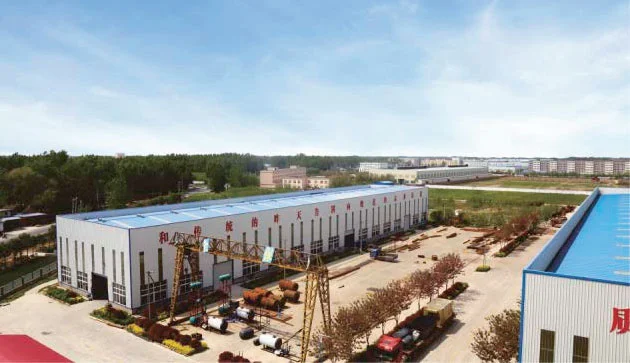
Yes. Henan Hengxin Boiler Co., Ltd. builds to client drawings and can adapt the furnace, grate, insulation, instrumentation and electrical supply to local conditions, including 60 Hz systems and non-standard fuels. The company holds ISO 9001 and ISO 14001 certification and a special equipment manufacturing license, and has completed projects across Asia, Africa and Latin America. A general arrangement drawing, a fuel analysis and the site conditions are enough to start a quotation.
For a copra mill, the boiler is the smallest item in the capital plan and the one that decides whether the refinery can run at all. Send Henan Hengxin Boiler Co., Ltd. the daily copra tonnage, the shift pattern, the refining steps in use, the shell analysis and the chimney height allowed on site, and the engineering team will return a steam balance, a model recommendation and a room layout. From a single DZH0.5 unit for a village mill to a DZH6 for a larger press line, the DZH biomass boiler turns a waste heap into dry, stable process steam.