
Company News
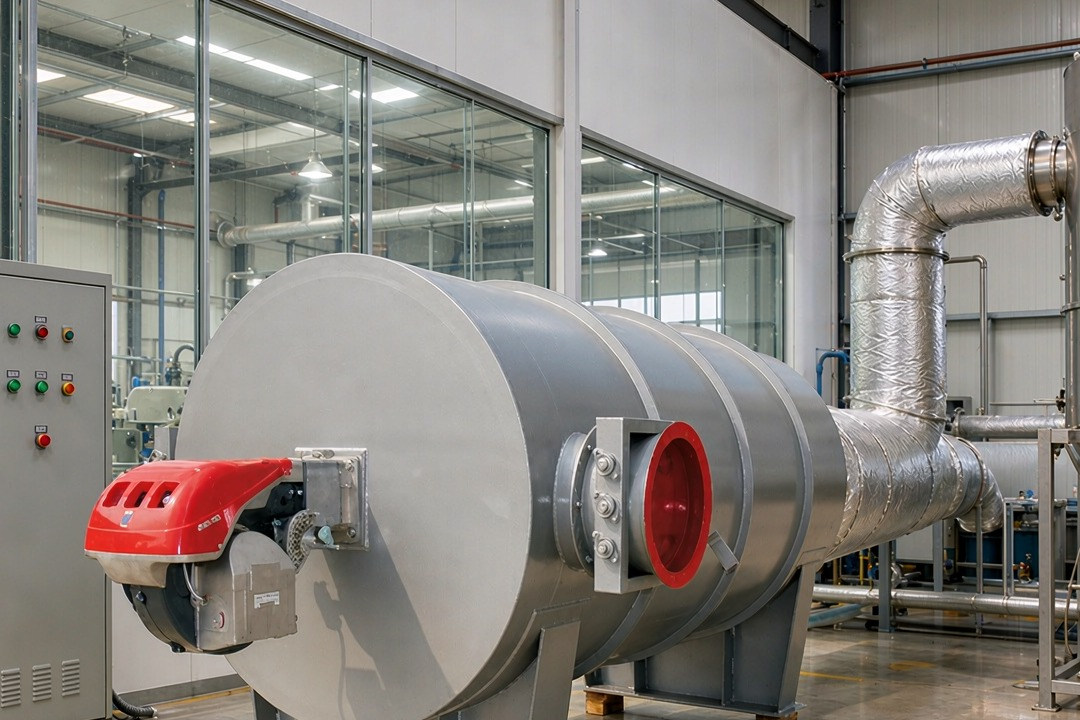
Every square metre of porcelain tile begins as a liquid. The slip leaves the ball mill at about 33 to 35 percent moisture, and before it can be pressed into a green body it must become a free flowing granulated powder at about 6 to 7 percent moisture. That transformation happens in the spray dryer, and the spray dryer lives or dies by its hot air source. If the air is not hot enough the tower loses tonnage, if it swings the powder moisture drifts, and if it is not clean the finished tile shows iron spots and specks that polish out as rejects. This article works through what a ceramic plant actually needs from its hot air source, why indirect heating is the right architecture for a white body plant, and how to size and install a unit from the WRF-Y(Q) series oil and gas fired hot air furnace range on a real spray drying duty.
The planning figures below suit body preparation lines of roughly 80 to 100 tonnes of dried powder per day, which is the size class of a single medium spray tower. They are estimates for engineering discussions; a final selection should always be confirmed against the slip density, tower geometry, altitude and ambient humidity of the actual site.
A spray dryer is a one pass evaporator. Fine droplets of slip are injected into a stream of hot air at the top of the tower, water flashes off in the two or three seconds of fall, and dry granules exit through the cone at the bottom while humid air leaves through the exhaust. The energy for all of that evaporation arrives as sensible heat in the air, so the furnace feeding the tower is effectively the engine of body preparation. Three characteristics decide whether it is fit for the duty.
First, capacity with reserve. The tower is rated in tonnes of powder per day, and that rating collapses quickly when inlet air temperature cannot be held because the furnace is saturated. Second, temperature stability. Powder moisture tracks tower outlet temperature almost linearly, so an inlet air source that holds within a few kelvin keeps the granulation within specification without operator intervention. Third, air cleanliness, because the air touches the product itself and later ends up pressed into the tile. An oil and gas fired indirect hot air furnace satisfies all three at once: it modulates cleanly on gaseous or light liquid fuel, holds outlet temperature automatically, and by design never lets combustion products touch the process air.
Before sizing, list every consumer of hot air around the tower. The table below shows a representative line with its neighbours.
| User | Air temperature | Load character | Consequence of a shortfall |
|---|---|---|---|
| Spray dryer tower inlet air | 250 to 300 degrees Celsius, some duties up to 350 | Continuous, dominant, tightly controlled | Tonnage falls, powder moisture rises |
| Green body dryer branch | 80 to 130 degrees Celsius mixed air | Continuous between shifts | Wet tiles crack before firing |
| Slip room and pump house heating | 15 to 25 degrees Celsius room air | Winter, small | Comfort and slip viscosity only |
| Plant hot water | 45 to 60 degrees Celsius via plate exchanger | Continuous, small | Staff services |
| Tower start-up preheat | Ambient to setpoint | Large short peak, once per start | Slow start-up, off spec first hours |
Two features of this map drive the design. The tower is the only large load and it runs continuously for the full shift plan, so the furnace should sit near 70 to 80 percent of rating in steady operation with real reserve for start-up preheat. The green body dryer branch is small but cannot be allowed to freeze when the tower pulls hard, which is why both branches get independent control rather than sharing one duct by hand.
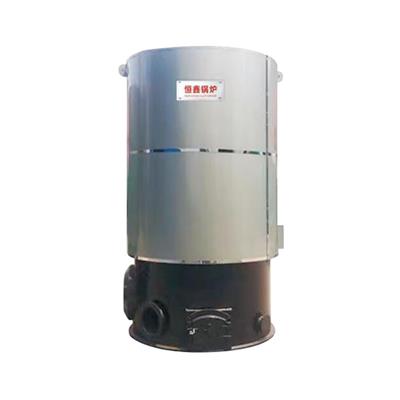
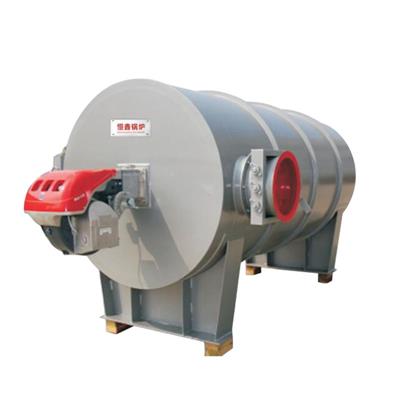
Ceramic powder is a white, iron sensitive product, and the defects caused by dirty process air are expensive precisely because they appear after pressing, firing and polishing. Indirect heating is the structural answer. In the WRF-Y(Q) concept the burner fires into a furnace core made of heat resistant SUS304 stainless steel, the flue gas stays inside that core and the multi pass plate heat exchanger, and the process air is heated on the outside of the exchange surfaces and delivered through an inlet air filter. Combustion products, sulphur and soot never enter the tower, so the granules leave with the same whiteness the slip had.
The range addresses the details that make indirect designs work in practice. The furnace core is SUS304 with a 150 millimetre insulation layer, so radiation losses stay low and the steel does not scale and shed oxide into the air path. A three circuit cross flow plate exchanger keeps the exchange surfaces accessible and the unit compact. A waste heat recovery option on the flue side lifts overall heat exchange efficiency above 90 percent and trims fuel consumption by 5 to 8 percent compared with a plain furnace, which on a continuously running tower is a meaningful annual sum. Clean air is not a slogan here, it is the reason a ceramic plant should not consider a direct fired solution for this duty.
The catalogue header lists a standard delivered band of 0.6 to 2.4 MW rated heat power, while the model table covers fifteen ratings from 60 to 4,200 x 10,000 kcal per hour, which spans roughly 0.07 to 4.88 MW. Working pressure is atmospheric on the air side, the rated air outlet temperature spans 100 to 400 degrees Celsius, and the design fuel is natural gas or light oil. Verified figures from the product specification page are summarised below.
| Model | Heat power (x10,000 kcal/h) | Approx. output (MW) | Natural gas (Nm3/h) | Light oil (kg/h) | Transport size LxWxH (m) |
|---|---|---|---|---|---|
| ZRFQ-5-YQ | 60 | 0.07 | 3.5-11.5 | 7-14 | 1.5x0.6x0.8 |
| ZRFQ-10-YQ | 120 | 0.14 | 10-28 | 13-26 | 2.6x0.9x1.2 |
| ZRFQ-20-YQ | 240 | 0.28 | 8-41 | 15-33 | 2.7x1.0x1.3 |
| ZRFQ-30-YQ | 350 | 0.41 | 8-41 | 15-33 | 2.5x1.1x1.45 |
| ZRFQ-40-YQ | 500 | 0.58 | 8-41 | 15-33 | 3.5x1.2x1.55 |
| ZRFQ-60-YQ | 700 | 0.81 | 20-85 | 20-75 | 3.5x1.3x1.65 |
| ZRFQ-80-YQ | 1050 | 1.22 | 30-120 | 30-90 | 4.0x1.4x1.75 |
| ZRFQ-100-YQ | 1200 | 1.40 | 5-150 | 35-110 | 4.0x1.5x1.85 |
| ZRFQ-120-YQ | 1400 | 1.63 | 50-210 | 67.5-177.1 | 4.0x1.7x2.05 |
| ZRFQ-150-YQ | 1750 | 2.04 | 50-260 | 80-220 | 4.9x1.8x2.2 |
| ZRFQ-200-YQ | 2400 | 2.79 | 90-320 | 100-290 | 5.2x1.9x2.3 |
| ZRFQ-240-YQ | 2800 | 3.26 | 50-360 | 80-329 | 5.6x2.0x2.4 |
| ZRFQ-300-YQ | 3600 | 4.19 | 100-450 | 120-360 | 5.6x2.05x2.5 |
| ZRFQ-360-YQ | 4200 | 4.88 | 100-450 | 120-360 | 5.6x2.1x2.6 |
| ZRFQ-400-YQ | 4200 | 4.88 | 100-450 | 120-360 | 6.0x2.1x2.6 |
The largest unit ships within a 6.0 by 2.1 by 2.6 metre transport envelope, which means even a 4.9 MW furnace travels as ordinary road cargo and lands beside the tower without special lifting plans. Fully automatic control keeps the drying temperature in a 60 to 220 degree Celsius band with automatic transition between high and low fire, and after flame off the burner fan continues for fifteen minutes to sweep and cool the chamber.
Per tonne of spray dried powder, the water balance is fixed by the two moisture points. Slip at 34 percent moisture and powder at 6.5 percent moisture give about 417 kilograms of water evaporated per tonne of powder. A tower rated around 86 tonnes of powder per day on a twenty hour plan therefore evaporates about 1,800 kilograms of water per hour.
Well maintained indirect spray drying installations run at roughly 3,200 to 3,500 kilojoules per kilogram of water evaporated, where the figure covers heating the slip droplets, evaporating the water and the shell and duct losses of the tower. At 3,300 kilojoules per kilogram, 1,800 kilograms per hour demands about 5.94 gigajoules per hour, or 1,650 kilowatts of useful heat delivered to the tower.
The green body dryer branch and winter services add a small continuous demand. Because the tower dominates and runs flat out while the others are intermittent, a diversity factor of 0.90 is realistic, followed by a 10 percent margin for fouling, altitude and humidity swings.
Pick the rating that puts the steady point in the modulating band of the burner. The table works the example end to end.
| Load | Basis | Demand |
|---|---|---|
| Spray tower evaporation | 1,800 kg/h x 3,300 kJ/kg | 1,650 kW |
| Green body dryer branch | Continuous mixed air users | 120 kW |
| Slip room and hot water | Winter services | 20 kW |
| Connected load | 1,790 kW | |
| Diversity at 0.90 | 1,790 x 0.90 | 1,611 kW |
| Margin at 10 percent | 1,611 x 1.10 | 1,772 kW design output |
| Model selection | ZRFQ-200-YQ at 2,400 kW | About 74 percent in steady running |
ZRFQ-150-YQ at 1,750 kilowatts sits at 101 percent of the design output and is correctly rejected, because a furnace that must run flat out has no reserve for start-up preheat and no modulating room on mild days. ZRFQ-200-YQ carries the steady duty at about 74 percent, absorbs the tower preheat peak without strain, and still holds acceptable efficiency at partial load because the burner transitions between high and low fire automatically. For a plant planning a second tower, ZRFQ-240-YQ at 2,800 kilowatts is the step up to discuss before civil works begin.
The tower inlet temperature is the loop that protects product quality, so it should be closed properly. The burner firing rate gives the coarse adjustment and a dilution air damper at the furnace outlet gives the fine trim, which lets the control catch fast changes in slip flow without hunting the burner. Furnace outlet thermocouples need annual calibration, and the automatic control that holds drying temperature in its 60 to 220 degree Celsius band should be checked against a reference probe at commissioning.
Green tiles are dried on a separate temperature level, so the dryer branch takes its own air from a second take-off and mixes it down to 80 to 130 degrees Celsius with ambient air through a motorised damper. This keeps a slow drying curve available even while the tower is at full pull, and it means the dryer branch can run overnight on low fire without dragging the tower off temperature. Isolation dampers on both branches allow either user to be shut for service without stopping the furnace.
Keep the furnace close to the tower, because every metre of hot air duct costs temperature and money; insulate with 100 to 150 millimetres and fit expansion bellows for the 250 to 300 degree Celsius duty. On the safety side the interlock set should include airflow proven before burner start, a high temperature cut out on the furnace outlet, flame supervision on the burner, and the standard post shutdown sweep in which the fan continues for fifteen minutes to cool the chamber. These are catalogue features of the range, but they must be wired, tested and documented on site like any other safeguard.
Planning values for one megawatt hour of useful heat delivered to the tower are listed below, assuming a net utilisation of about 92 percent after duct and exchanger losses; sites with the waste heat recovery option do better than these figures.
| Fuel | Approximate consumption per MWh useful heat | Practical notes |
|---|---|---|
| Natural gas | About 109 Nm3 | Preferred where the pipeline reaches the cluster |
| LPG | About 85 kg | Suits non pipeline sites with tank supply |
| Light oil | About 92 kg | Store warm and filter; watch sulphur content |
For the worked example the tower consumes about 33 megawatt hours of useful heat in a twenty hour day, which is close to 3,600 cubic metres of natural gas or the light oil equivalent. In ceramic clusters the gas grid is usually available, which keeps fuel cost predictable; where it is not, LPG or light oil are fully supported design fuels of the range, and the burner selection changes rather than the furnace.
| Item | What to verify |
|---|---|
| Siting | Furnace close to the tower, level foundation, clear burner pull out space, transport envelope checked against the access road |
| Gas train | Regulation skid sized for maximum flow, leak test, two automatic valves plus vent, correct governor setting |
| Air path | Inlet filter fitted with a differential pressure gauge, duct joints airtight, insulation complete, expansion bellows free |
| Instrumentation | Tower inlet and outlet thermocouples calibrated, dilution damper travel confirmed, furnace outlet high limit tested |
| Controls | High low fire transition observed, cascade tower inlet control tuned, dryer branch mixing damper tuned |
| Safety | Airflow proving, flame supervision, fifteen minute post shutdown sweep, emergency stop tested |
| Site factors | Altitude and summer humidity checked against the air mass calculation, fuel consumption re-estimated for the worst month |
| Interval | Task |
|---|---|
| Daily | Log furnace outlet and tower inlet temperatures, burner behaviour, filter differential pressure |
| Weekly | Inspect filter media, check damper actuators, test safety cut outs, inspect duct insulation hot spots |
| Monthly | Check burner electrodes and nozzle, inspect gaskets and door seals, verify thermocouple readings against a reference |
| Quarterly | Clean exchange surfaces where accessible, review combustion flue gas readings, tighten electrical connections |
| Annually | Full exchanger inspection, furnace core weld and scale survey, insulation repair, complete interlock test with records |
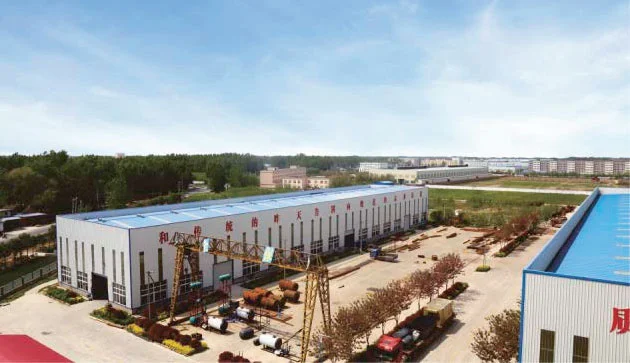
A hot air furnace feeding a spray tower runs thousands of hours a year at high temperature, so the manufacturer behind it should prove more than a catalogue. Henan Hengxin Boiler Co., Ltd. manufactures under a special equipment production licence and holds ISO9001 and ISO14001 certification with 3A enterprise credit standing, and the certificates page lists the documents for review. Building materials and drying duties are established application fields of the product platform, as the application pages record. Standard models cover the fifteen ratings in the table above, and the company also builds to customer drawings and develops custom configurations for unusual capacity points, special duct arrangements, integrated dilution and mixing skids, and control integration with the tower PLC or a plant DCS. For a ceramic project, supplying the tower rating, slip moisture points, altitude and fuel situation is usually enough for a factory proposal with layout, air flow estimate and delivery time.
Yes. The worked example above includes both users in one connected load: the tower takes its high temperature branch straight from the furnace, while the green body dryer draws a separately mixed branch at 80 to 130 degrees Celsius. Independent control valves and isolation dampers let each branch hold its own curve, and the sizing margin covers running both at once.
Most porcelain and stoneware towers run with inlet air at 250 to 300 degrees Celsius, and some high tonnage installations go up to about 350 degrees Celsius. The ZRFQ range delivers 100 to 400 degrees Celsius at atmospheric pressure, so the whole duty sits comfortably inside the catalogue window with room for start-up preheat.
Direct firing mixes combustion products into the process air, which adds moisture, sulphur compounds and soot to air that touches a white, iron sensitive product, and it also makes tower humidity control harder. Indirect heating keeps the flame inside a SUS304 core and the flue gas inside the plate exchanger, so only clean filtered air reaches the droplets, and speck defects attributable to the air source are eliminated at the design level.
For the example tower evaporating 1,800 kilograms of water per hour over twenty hours, about 33 megawatt hours of useful heat per day, close to 3,600 cubic metres of natural gas on the planning values above. Actual consumption follows slip moisture, tower condition and ambient humidity, which is why the commissioning checklist asks for the worst month to be re-estimated rather than the average one.
Ceramic plants that move spray drying to a properly sized indirect hot air furnace almost always report the same two gains: powder moisture and granule quality become repeatable because tower inlet temperature stops hunting, and speck claims stop appearing because the process air is genuinely clean. Both begin with an honest heat balance of the tower, not with a brochure. Henan Hengxin Boiler Co., Ltd. supports that first step with application engineers who size hot air systems across building materials, grain, food, chemical and drying duties, and the company welcomes drawings and data for custom development. Send the tower rating, the slip and powder moisture points and the fuel situation, and a sizing proposal with layout and fuel figures follows for review before any commitment is made.