
Company News
A modern feed mill does not only grind and mix raw materials, it cooks them gently. In the conditioner sitting above a ring die pellet press, dry saturated steam mixes with the mash, raises its temperature to the gelatinization window and softens the starch so the material flows through the die holes instead of shattering at them. Mills that run with good steam conditioning report smoother die throughput, higher pellet durability and fewer fines returned to the regrind loop. Mills that run with wet or unstable steam see blocked dies, crumbling pellets and a pellet durability index that drifts from shift to shift.
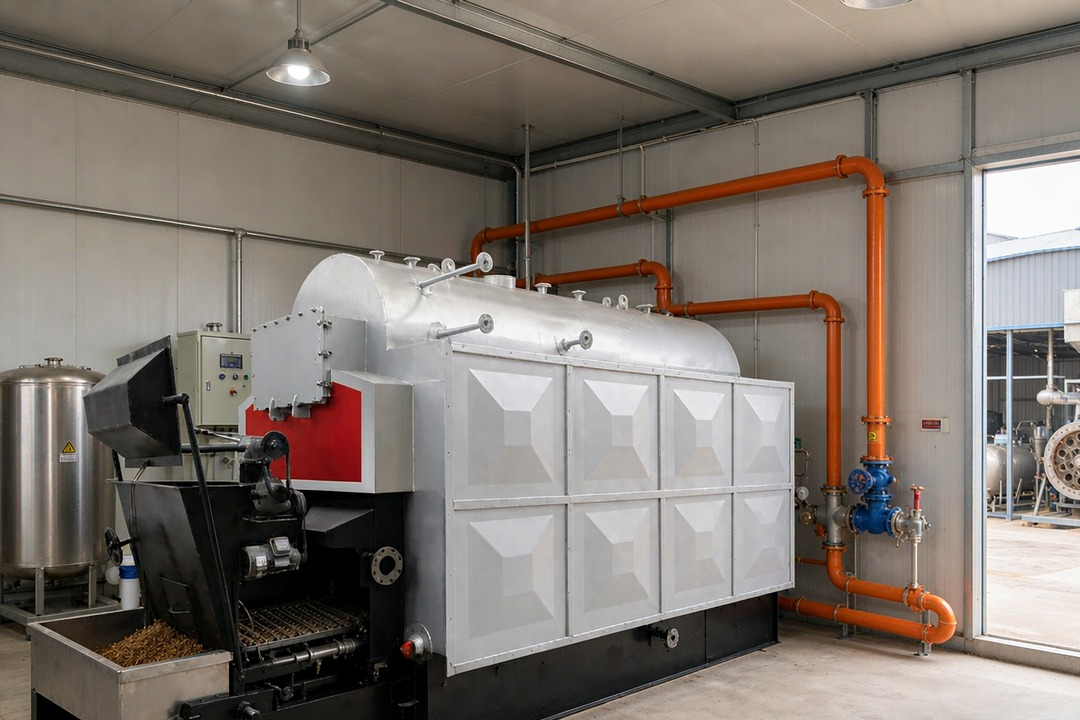
The steam plant behind this process deserves the same engineering attention as the pellet press itself. In many feed producing regions, from the grain belts of Asia to the maize and soy growing zones of Africa and South America, a gas pipeline is not available at the factory fence, while rice husk, wood chips, corn cob, straw briquettes and coal are all within trucking distance. This is the operating environment the DZL biomass (coal) fired steam boiler was built for: a single drum, horizontal chain grate boiler in the 0.5 to 10 t/h class delivering 1.25 MPa saturated steam, fired automatically on local solid fuel. This article walks feed mill owners, project engineers and purchasing teams through the steam users in a pellet line, the sizing method, the DZL model range, fuel consumption and the practical details of running a solid fuel boiler house next to a feed production building.
Steam demand in a feed mill concentrates on a few stations, and each station has its own pressure comfort zone. The figures below are indicative planning ranges; the nameplate data of the actual pellet presses and extruders always take precedence in a final design.
| Steam user | Typical steam share of line throughput | Supply pressure band | Notes |
|---|---|---|---|
| Conditioner above a ring die pellet press | 3 to 5 percent | 0.4 to 0.8 MPa | The main consumer; drives gelatinization and die lubrication |
| Preconditioner of an extrusion line for aquafeed or pet food | 6 to 8 percent | 0.5 to 0.8 MPa | Higher moisture pickup before the extruder barrel |
| Steam flaking or rolling of maize and barley | 2 to 4 percent | 0.3 to 0.6 MPa | Present in cattle feed plants with flaking lines |
| Hot water generation for mixing and cleaning | varies with batch schedule | 0.3 to 0.5 MPa | Often served through a plate heat exchanger and buffer tank |
| Space heating of the mill in the cold season | seasonal | 0.2 to 0.4 MPa | Radiators or air unit heaters on a separate reducing station |
Conditioner manufacturers consistently ask for dry steam, because condensate carried into the conditioner creates wet patches in the mash and soft spots in the pellet. A boiler generating at 1.25 MPa holds saturated steam at 194 degrees C in the header. When that steam passes through a pressure reducing valve down to the 0.6 to 0.8 MPa band the conditioners prefer, it leaves the valve slightly superheated and unmistakably dry, which is exactly what the process wants. Running the boiler at its rated pressure and reducing at the header therefore protects pellet quality twice: the boiler operates at its design point, and the conditioner receives dry steam even on long pipe runs. Steam traps at the low points of the mains and insulation on every branch complete the picture.
Different recipes ask the steam system for different work. The conditioning temperature and the steam addition rate both move with the starch and fat content of the formula, so a multiproduct mill needs a boiler that follows a changing load profile through the day.
| Feed type | Conditioning temperature | Typical steam addition |
|---|---|---|
| Poultry broiler pellets | 70 to 85 degrees C | 3 to 5 percent |
| Pig grower and creep pellets | 75 to 90 degrees C | 4 to 6 percent |
| Cattle feed pellets and steam flaked grain | 65 to 80 degrees C | 4 to 6 percent |
| Aquafeed, extruded shrimp and fish feed | 85 to 95 degrees C | 6 to 8 percent |
| Pet food kibble, extruded | 85 to 95 degrees C | 6 to 10 percent |
A mill that switches between poultry pellets in the morning and shrimp feed in the afternoon therefore swings its steam demand by a factor of two without changing the recipe book. The wide modulation range of a DZL chain grate boiler, together with its large furnace volume, absorbs this swing better than an undersized unit that must cycle on and off, and cycling is what shortens the life of any pressure vessel.
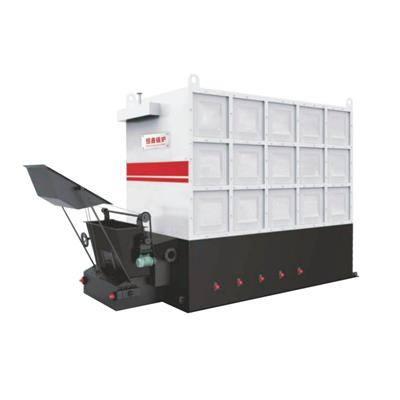
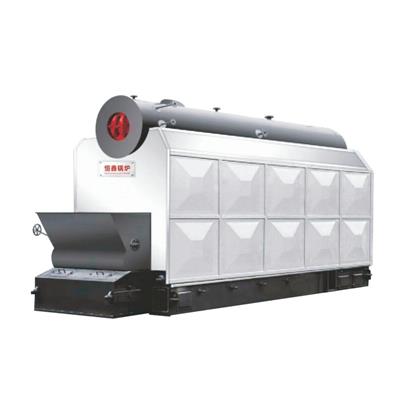
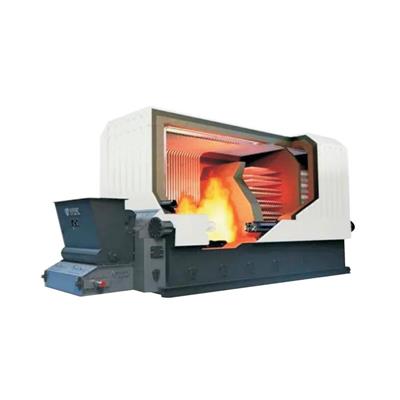
The DZL series is a horizontal three pass water fire tube boiler with a single drum positioned along the boiler axis and a small scale type chain grate at the furnace floor. Several construction choices translate directly into feed mill value. Threaded smoke tubes turbulate the flue gas as it crosses the second and third passes, lifting heat transfer and supporting the rated thermal efficiency of 83 percent or better. A membrane water wall surrounds the furnace, raising the heat absorbing surface and cutting wall losses. The rear tubesheet is arched rather than flat, a geometry that softens the stress around the tube field and, together with the two wing flue passages that equalize the gas temperature entering the front smoke box, reduces the tubesheet cracking risk that historically troubled boilers of this layout.
Combustion is staged by an inverted alpha flame arch, which holds the flame longer over the grate and widens the range of fuels the furnace accepts, from free flowing pellets to coarse chips and coal. The grate itself is a small scale type chain design with a safety ring that keeps the grate bars tracked and stable through long campaigns. Because the grate is mechanically stoked, one operator supervises several hours of continuous firing instead of shoveling fuel by hand, which matters in a mill where the boiler house usually shares its staff with the production floor. Behind the boiler, the flue train can carry an economizer and a dust collector so that heat leaves the plant only once and the stack stays within the local dust limits.
Eight standard steam models cover the window that matches feed mills from a single press line to a multiproduct campus. All models share the same 1.25 MPa pressure class and the same declared design fuel of coal and biomass.
| Model | Capacity (t/h) | Pressure (MPa) | Saturated steam (degrees C) | Efficiency | Transport weight (kg) | Transport size L x W x H (mm) |
|---|---|---|---|---|---|---|
| DZL0.5-1.25-SCIII | 0.5 | 1.25 | 194 | at or above 83% | 11000 | 3300 x 2000 x 2656 |
| DZL1-1.25-SCIII | 1 | 1.25 | 194 | at or above 83% | 15000 | 5200 x 2100 x 2600 |
| DZL2-1.25-SCIII | 2 | 1.25 | 194 | at or above 83% | 23000 | 5650 x 2400 x 2700 |
| DZL3-1.25-SCIII | 3 | 1.25 | 194 | at or above 83% | 24000 | 5700 x 2600 x 2800 |
| DZL4-1.25-SCIII | 4 | 1.25 | 194 | at or above 83% | 29000 | 6850 x 2700 x 3200 |
| DZL6-1.25-SCIII | 6 | 1.25 | 194 | at or above 83% | 32000 | 6800 x 2900 x 3400 |
| DZL8-1.25-SCIII | 8 | 1.25 | 194 | at or above 83% | 35000 | 7200 x 3200 x 3800 |
| DZL10-1.25-SCIII | 10 | 1.25 | 194 | at or above 83% | 40000 | 7900 x 3400 x 5500 |
The units ship as packaged boilers with the pressure parts assembled in the works, so site work reduces to foundations, water and steam piping, the fuel feeding conveyor and the flue. For campus scale mills that outgrow the 10 t/h class, the same product family continues upward in the SZL double drum chain grate boiler, which shares the grate and combustion philosophy in a larger frame, and the two series are commonly quoted together when a mill plans a second construction phase.
Step 1. List the steam users with their throughput and steam share. In a feed mill this means each pellet press with its conditioner, each extrusion line with its preconditioner, and the services users such as hot water and winter heating.
Step 2. Apply a demand factor. Not every line runs its maximum recipe at the same hour: conditioners follow the recipe book, the extruder may run single shift, and heating loads appear only in the cold months. A demand factor between 0.85 and 0.95 reflects typical simultaneous operation in a mill with two or three presses.
Step 3. Add a margin of about 15 percent for distribution losses, blowdown and formulation changes, then read the required boiler capacity in tonnes per hour.
Step 4. Check the load point. A boiler that lands at roughly 65 to 85 percent of rated capacity at peak runs in its efficient band and keeps reserve for new lines.
| Steam user | Basis | Connected demand (kg/h) |
|---|---|---|
| Pellet press line 1, poultry feed | 10 t/h at 5 percent steam | 500 |
| Pellet press line 2, poultry feed | 10 t/h at 5 percent steam | 500 |
| Extruder preconditioner, aquafeed | 3 t/h at 7 percent steam | 210 |
| Hot water and plant services | batch schedule | 100 |
| Connected total | 1310 | |
| After demand factor 0.9 | 1179 | |
| After 15 percent margin | about 1360 |
A DZL2 with 2 t/h of rated capacity carries this peak at about 68 percent load, which sits inside the target band and leaves room for a third press. If the extrusion line is expected to grow into a second extruder within two years, the procurement team can compare a DZL4 running with more reserve against a two boiler arrangement of a DZL2 plus a DZL1, which adds redundancy for harvest season peaks and keeps one boiler available when the other is washed and inspected.
Budgeting fuel is where a solid fuel boiler earns or loses its keep. One tonne of steam from 20 degrees C feedwater requires about 2.7 GJ of heat, and at the rated efficiency of 83 percent the furnace must release about 3.25 GJ of fuel energy. The table converts that figure into the local trading units for the fuels a feed mill region usually offers.
| Fuel | Typical net heating value | Consumption per tonne of steam at 83 percent |
|---|---|---|
| Wood pellets | about 17.5 MJ/kg | about 186 kg |
| Wood chips | about 13.5 MJ/kg | about 241 kg |
| Rice husk | about 13.0 MJ/kg | about 250 kg |
| Corn cob briquettes | about 15.0 MJ/kg | about 217 kg |
| Straw or peanut shell briquettes | about 14.5 MJ/kg | about 224 kg |
| Coal, about 5000 kcal/kg | about 20.9 MJ/kg | about 156 kg |
A feed mill often generates combustible residues of its own, most commonly rice husk in rice growing regions and corn cob in maize regions. Screening and burning these residues in the DZL turns a disposal cost into a fuel credit, although most mills keep purchased pellets or chips as the balancing fuel because their own residue stream is seasonal. Multiply the hourly figure by the production plan to size the fuel yard: the worked example above produces about 1.36 t of steam per peak hour, so a DZL2 on wood chips consumes roughly 3.3 t over an eight hour shift, and a five day buffer store fits in a covered bay next to the raw material silos.
| Planning item | Practical guidance for a feed mill |
|---|---|
| Boiler house location | Place it between the raw material intake and the process building so both fuel delivery and steam mains stay short; keep dust generating operations such as grinding and bagging out of the boiler house itself |
| Foundation | Reinforced concrete plinth sized to the transport weight of the chosen model, level within the supplier tolerance drawing |
| Fuel handling | Drag chain or belt conveyor from the covered store to the grate hopper, with a magnetic separator where baled straw or bagged residues may carry tramp metal |
| Feedwater and treatment | Softener matched to local hardness, feedwater tank with preheating, chemical dosing; hardness control protects the threaded tubes and the tubesheet for the life of the boiler |
| Steam distribution | Header with isolation valves, reducing stations to the 0.6 to 0.8 MPa conditioner band, insulated mains routed to keep slopes and trap points toward the pellet presses |
| Condensate return | Vented receiver and return pump; returning hot condensate from the conditioners and hot water users cuts fuel use and water treatment cost visibly |
| Flue path | Economizer option, dust collector, chimney height per the local environmental approval |
| Ash handling | Ash pit or steel bins under the rear slag discharge; biomass ash is commonly passed to local farms as a soil amendment |
| Electrical and controls | Feedwater pump control, low water level interlock, high and low water alarms, grate speed control linked to steam pressure |
Because the DZL arrives as a packaged unit, commissioning on a prepared site is measured in weeks rather than months, and the boiler house civil work can run in parallel with the pellet line erection once the foundation drawing is released.
Feed production is seasonal, and the boiler house must live with it. Through the harvest and peak compound feed months the mill runs near the sizing peak described above, while the off season trims demand back toward services and occasional batches. Three habits keep the DZL healthy across this cycle. First, keep fuel moisture within sensible bands, below about 25 percent for chips and below 12 percent for pellets, because wet fuel steals furnace heat and drags both efficiency and steam pressure down at the worst moment. Second, keep the grate speed matched to steam pressure rather than chasing the needle manually; the automatic control modulates the feedwater and the water level alarms protect the boiler, and the operator role is supervision, ash and fuel logistics. Third, log feedwater hardness and blowdown at every shift change, because a solid fuel boiler that is fed hard water quietly loses its heat transfer margin long before anyone notices the fuel bill rising.
Between campaigns, the boxed nature of the water fire tube layout pays off in maintenance: smoke tubes are reachable from the front and rear smoke boxes, the tubesheet inspection follows the same route, and the annual internal inspection is a scheduled two to three day event in most mills rather than a production stopper.
Biomass carries little sulfur compared with most coals, so switching or blending toward biomass lowers the sulfur burden of the flue gas from the start. Dust is the parameter that local authorities watch in feed milling regions, and the DZL addresses it in two stages: the splayed furnace geometry and the outlet smoke window knock down a first share of fly ash inside the boiler, and a cyclone or multicyclone collector after the flue train catches the remainder, with a bag filter added where the local dust limit is stricter. The supplier sizes the collector together with the boiler so the package arrives matched.
On the compliance side, the boiler is manufactured under the special equipment regulations that govern pressure parts, and the operator registers and inspects the unit under its own national rules, which differ by country and capacity class. Purchasing teams should confirm the local classification for a 1.25 MPa boiler in the chosen size before ordering; the supplier documentation pack supports that registration.
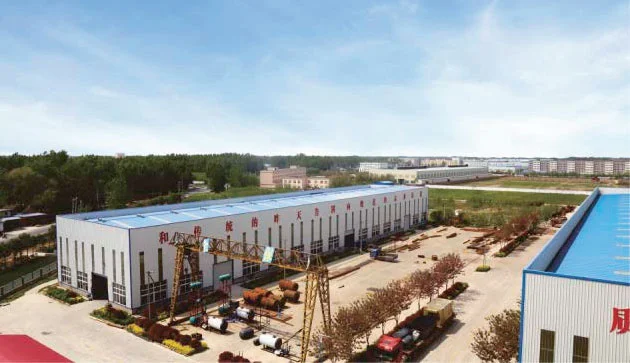
Henan Hengxin Boiler Co., Ltd. manufactures the DZL series under an ISO9001 quality management system and an ISO14001 environmental management system, holds the special equipment manufacture license required in China, and is rated a 3A credit enterprise. The certificates and licenses are published on the certifications and honors page so procurement teams can verify them directly. The factory brings four decades of boiler manufacturing, a production base of 660,000 square meters, 336 production machines and a catalog of more than 300 models.
Beyond the standard models, the factory supports drawing based customization and OEM work: nozzle positions rearranged for an existing steam header, fuel specific grate and furnace details for a particular local residue, taller chimneys or integrated dust collection for tight environmental permits, and export packing arranged for container or breakbulk shipment. Service is structured around the purchasing decision as well: technical consultation within 30 minutes, a clear proposal within 2 hours, engineer dispatch to the site in 24 to 72 hours where required, free maintenance for 12 months after shipment, and delivery windows of 15 days for boilers under 15 tonnes, 20 days for the 15 to 25 tonne class and 35 days above. Buyers mapping the wider use of steam in grain and food processing can browse the food and beverage industry application page for reference scenarios.
Yes, when it is sized on the connected load with an honest demand factor, as in the worked example. The chain grate follows the load mechanically, the large furnace volume smooths the swings between recipes, and the reducing stations give each user its own pressure band. Mills that cannot tolerate a single point of failure usually prefer two smaller boilers over one large unit, and both arrangements fit the DZL range.
Choose on delivered cost per gigajoule and on ash handling, not on the fuel label. Rice husk and corn cob are attractive where the mill generates them, chips are cheap near sawmills, and pellets burn most predictably with the least ash. Because the DZL is declared for both coal and biomass, the mill keeps the option to rebalance the fuel mix when one market tightens, which protects the feed conversion cost over the years.
Wet steam reaching a conditioner is a real quality risk, which is why the recommended arrangement generates at 1.25 MPa and reduces pressure at the header: the reduction leaves the steam dry and slightly superheated at the conditioner inlet. Steam traps at the low points, insulated mains and a separator before the conditioner remove the remaining condensate paths.
Yes. Drawing based customization covers nozzle arrangement, fuel feeding concept, dust collection and chimney options, skid mounted auxiliaries for compact boiler houses and packing for container or breakbulk transport. OEM production for equipment integrators is routine, and layout drawings accompany the quotation so civil work can start early.
Sizing a feed mill steam plant comes down to counting the presses, respecting the conditioning windows of the recipe book and landing the boiler at a sensible load point on local fuel. Send Henan Hengxin Boiler Co., Ltd. the line list, the local fuel prices and the site water analysis, and the engineering team will return a capacity proposal, an indicative fuel consumption table and a boiler house layout. From the 0.5 t/h DZL0.5 for a single press to the 10 t/h DZL10 for a multiproduct campus, the DZL biomass (coal) fired chain grate boiler turns regional solid fuel into the dry 1.25 MPa steam that keeps conditioners hot, dies open and pellet durability where the sales contract needs it.