
Company News
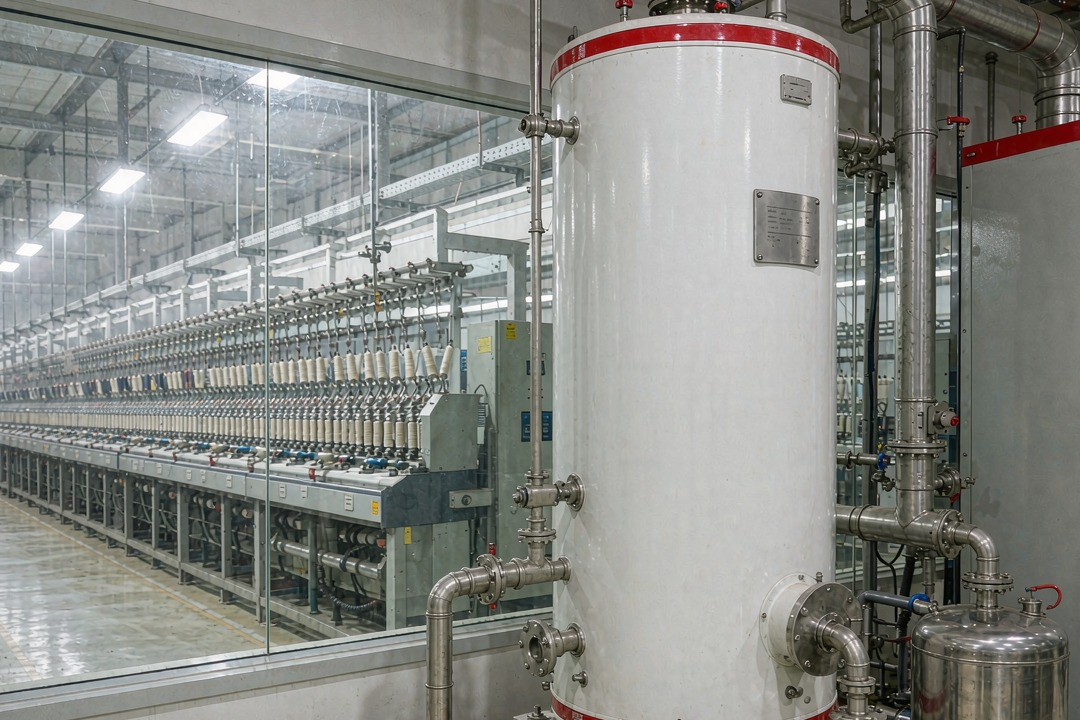
A spinning mill runs on two quiet utilities that never appear on the product label: conditioned air and small, precisely timed quantities of steam. Ring spinning and winding sheds hold 55 to 65 percent relative humidity through the winter to keep static electricity down and yarn breaks low, while the cone winding and twisting departments run batch after batch of yarn packages through steaming autoclaves so that twist sets, moisture equalizes and downstream weaving runs smoothly. Both duties need clean, dry, low pressure steam delivered inside a building full of workers and sensitive fibre, which is exactly the working envelope of the LDR electric heating boiler. This article works through the whole subject for buyers and plant engineers: why spinning mills need humidity steam and package steaming steam, why an electric boiler fits this environment better than a fuel fired one, the steam user map of a typical mill, a full sizing example, the model range, the electrical supply and operating cost figures, water treatment rules, installation and maintenance planning, and the mistakes that cost mills money every winter.
The worked example is a mill with about 25,000 spindles spread over four production sheds in a cold winter climate, which is a common scale for a regional spinning plant. The method transfers directly to smaller mills, wool and blends processing plants and twisting workshops, and the industry coverage of this boiler family can be reviewed on the textile boiler application page.
Textile fibres are hygroscopic, and their mechanical behaviour follows the moisture in the surrounding air. When the air in a spinning shed dries out, fibres charge up with static electricity, fly accumulates around the rings and travellers, yarn tensile strength drops and end breakage climbs, and in the worst cold snaps production crews spend more time piecing ends than running machines. Air conditioning engineers therefore hold spinning halls at 55 to 65 percent relative humidity at 25 to 30 degrees C, winding and prep areas slightly lower, and weaving preparation rooms slightly higher. In the heating season the outdoor air arriving through the ventilation system is far drier than that target, and the moisture deficit has to be injected back into the supply air, usually in air washer chambers or direct steam injection headers. Low pressure saturated steam is the standard medium for that injection because it condenses cleanly into the air stream without overheating it and without carrying any residue onto the fibre.
The second steam duty belongs to the twisting and winding department. Yarn packages leaving two for one twisters or ring frames carry unrelaxed twist and uneven moisture, and if they go straight to weaving or knitting they shed loops, snarls and shade variation. Package steaming autoclaves fix this: packages are loaded into a pressure vessel, the air is drawn out by vacuum, and saturated steam at roughly 0.15 to 0.3 MPa and 95 to 110 degrees C is admitted for a controlled soak before a second vacuum pull dries the surface. A batch takes 45 to 90 minutes including loading, and each heat up stage draws a sharp slug of steam, which makes the autoclave the peaky, batch driven consumer in the mill steam balance. Because the steam touches the yarn itself, it must be produced from properly treated boiler water and delivered dry, with no oil, no chemical carryover and no wet slug at the start of the cycle.
A fuel fired boiler brings a flue, a fuel store, combustion air and an emissions conversation into a building that is already full of people and fibre dust. An electric boiler has none of these: there is no burner, no flue gas, no fuel tank and no combustion air intake, so the unit can sit in a plant corner inside or directly beside the production building. That matters twice over for humidification duty, because the steam leaving the boiler is injected into the very air that operators breathe and that condenses onto yarn surfaces. Steam raised by immersed electric elements from treated water is about as clean as industrial steam gets, provided the water treatment side stays disciplined, which the water treatment section below covers.
Mills do not need humidity steam at three in the morning in July and do not need autoclave steam during a shift change in January, so the steam load swings hard across the day and the year. Electric boilers respond to that profile better than any fuel fired unit: the heating elements reach working pressure within minutes from a cold start, and the element banks switch on in stages, so the boiler tracks the load down to roughly 30 percent of rated output without the instability that plagues a small flame at low fire. A winter morning that starts with humidification at full tilt while an autoclave batch kicks on is handled by simply stepping in another element bank, and a summer night running one autoclave every few hours is handled by the smallest bank alone.
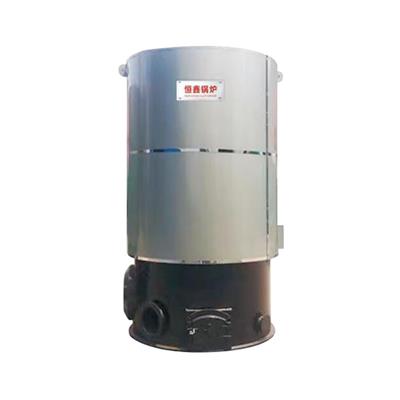
The LDR range is a family of vertical units with transport weights from about 150 to 1,600 kg and floor footprints from roughly 600 by 1,200 mm up to 1,300 by 1,800 mm, so the entire steam plant fits in a corner that a fuel fired boiler house would never fit into. There is no fuel storage area, no flue penetration through the roof of a production shed, and in many jurisdictions the permitting and inspection burden is lighter than for a fired pressure plant, though the classification always follows local code and should be confirmed with the local authority. For a mill that leases space in a multi tenant industrial building, this difference alone often decides the fuel question.
Good sizing starts with an honest map of who takes steam and when. The table below lists the typical consumers in a cotton and blend spinning mill with package steaming, with the design basis a plant engineer would use.
| Consumer | Design basis | Load character | What a shortfall costs |
|---|---|---|---|
| Winter air humidification in spinning and winding sheds | About 0.2 to 0.3 kg of steam per hour per 100 cubic metres per hour of fresh air in the coldest weeks | Steady through cold weather, zero in humid summer months | Static, yarn fly, rising end breaks, quality claims |
| Yarn package steaming autoclaves | About 200 to 300 kg per hour averaged over the heat up stage of a 1.5 to 2 cubic metre vessel | Sharp batch peaks every 45 to 90 minutes | Unset twist, snarling and shade variation downstream |
| Laboratory conditioning and sample steaming | 5 to 15 kg per hour | Working hours only | Test results drift from plant reality |
| Office and staff domestic hot water, cleaning | 10 to 20 kg per hour equivalent | Shift pattern | Housekeeping complaints |
| Distribution and trap losses | 5 to 8 percent of connected load | Constant | Hidden shortfall at the autoclave in cold snaps |
Two features of this map shape the whole design. First, the humidification load is weather driven and fades to nearly zero in the rainy season, while the autoclave load runs all year, so the plant must modulate deeply in summer instead of switching off. Second, the autoclave draws its steam in slugs, so either the boiler or the header needs buffering capacity, and the firing logic must be arranged so that an autoclave heat up does not collapse the humidification header pressure at the moment the sheds need it most.
The example mill runs four conditioned sheds with a combined treated air volume of about 100,000 cubic metres per hour, of which roughly 20,000 cubic metres per hour is fresh air in the coldest weeks, and one package steaming autoclave of about 2 cubic metres working in batches.
| Consumer | Basis | Connected load (t/h steam) |
|---|---|---|
| Winter humidification | 20,000 cubic metres per hour fresh air at about 1.25 kg per cubic metre, moisture deficit about 9 g per kg, plus washer losses | 0.24 |
| Package steaming autoclave | Heat up stage of a 2 cubic metre vessel, averaged draw | 0.25 |
| Laboratory and sample conditioning | Working hours | 0.06 |
| Domestic hot water and cleaning | Shift pattern | 0.00 (served from condensate recovery and washing points) |
| Distribution and trap losses | About 8 percent of the above | 0.05 |
| Connected total | 0.60 |
The autoclave heat up peak and the steady humidification draw overlap only partly, because batches are scheduled across the shift and the vessel spends part of each cycle in soak and vacuum stages with little steam demand. A diversity factor of 0.85 is honest for this mix and gives 0.51 t/h, and a design margin of 15 percent for element fouling growth, insulation drift and unusually cold weeks brings the design duty to about 0.59 t/h, which rounds to 0.6 t/h of installed steam capacity.
| Option | Configuration | Operating point | Assessment |
|---|---|---|---|
| A | Single LDR0.7 serving a common header | 0.6 of 0.7 t/h, about 85 percent | Covers the duty but leaves no redundancy and couples the autoclave slug to the humidification header, so a breakdown stops both duties |
| B (recommended) | LDR0.5 on the humidification and house line, LDR0.3 dedicated to the autoclave | 0.40 of 0.50 t/h, about 80 percent; 0.25 of 0.30 t/h, about 83 percent | Each unit sits at a healthy load, the autoclave slug is contained on its own circuit, and a breakdown of one unit leaves the mill half served instead of dark |
| C | Single LDR1.0 | 0.6 of 1.0 t/h, about 60 percent | Runs the whole plant most days on low stage with single unit risk, and spends capital on capacity the mill rarely calls |
Option B is the standard answer for mills at this scale: two small vertical units cost little more to install than one larger unit, and the dedicated autoclave boiler makes batch scheduling independent of the weather. Mills with two or more autoclaves should size the dedicated unit for the largest simultaneous draw or stagger the batches through the autoclave controller.
The LDR range covers the small steam duties of a spinning mill in six vertical models, with the following verified parameters from the product page: rated steam capacity 0.1 to 1.0 t/h, working pressure options of 0.4 or 0.7 MPa, saturated steam temperature of 151 or 171 degrees C, and thermal efficiency of 98 to 99 percent on the electrical input, since an electric boiler has no stack to lose heat through.
| Model | Rated steam (t/h) | Approx. electrical load (kW) | Working pressure (MPa) | Steam temperature (degrees C) |
|---|---|---|---|---|
| LDR0.1 | 0.1 | about 80 | 0.4 / 0.7 | 151 / 171 |
| LDR0.2 | 0.2 | about 160 | 0.4 / 0.7 | 151 / 171 |
| LDR0.3 | 0.3 | about 235 | 0.4 / 0.7 | 151 / 171 |
| LDR0.5 | 0.5 | about 390 | 0.4 / 0.7 | 151 / 171 |
| LDR0.7 | 0.7 | about 550 | 0.4 / 0.7 | 151 / 171 |
| LDR1.0 | 1.0 | about 780 | 0.4 / 0.7 | 151 / 171 |
All models use stainless steel tubular electric heating elements immersed in the water space, staged element switching with a minimum stable output of about 30 percent of rating, pressure and water level controls with automatic cutouts, and electrical components from established brands such as Siemens and ABB, with CE and CCC certification. For humidification duty the 0.4 MPa setting is usually sufficient and the lower saturation temperature reduces heat stress on the air washer; for autoclave work the 0.7 MPa setting gives margin over the 0.15 to 0.3 MPa vessel range after pressure reduction.
Electric steam generation converts electrical input to steam almost one to one, so the boiler is one of the largest single electrical consumers in the mill and the supply study belongs in the project before the order. As a planning figure, one tonne of steam from cold feedwater takes roughly 780 kWh of electricity, and the current draw of each model at a 400 volt three phase supply is approximately as follows.
| Model | Approx. electrical load (kW) | Approx. current at 400 V three phase (A) |
|---|---|---|
| LDR0.1 | 80 | 120 |
| LDR0.2 | 160 | 245 |
| LDR0.3 | 235 | 360 |
| LDR0.5 | 390 | 590 |
| LDR0.7 | 550 | 840 |
| LDR1.0 | 780 | 1,190 |
Staged element starting keeps the inrush manageable, but the transformer still needs confirmed headroom above the connected boiler load, feeders and protection need sizing for continuous full load, and the element staging should be sequenced so that the two units of option B do not step up simultaneously. Where the mill pays demand charges, the autoclave controller can be programmed to avoid heat up during the humidification morning ramp, which flattens the peak the utility bills on.
| Energy source | Consumption per tonne of steam | Note |
|---|---|---|
| Electricity, LDR boiler | about 780 kWh | No flue losses, no fuel storage, no burner maintenance |
| Natural gas, fired boiler | about 80 cubic metres | Requires flue, fuel train and combustion air |
| LPG | about 62 kg | Tank and vapourizer on site |
| Light diesel | about 68 kg | Tank, pump set and burner spares |
Which column wins depends entirely on local tariffs, and buyers should multiply each consumption figure by their own delivered prices before deciding. Two structural points favour electricity in many mill locations: off peak tariffs can be exploited by scheduling autoclave batches into the night, and rooftop photovoltaic arrays, which textile mills increasingly install, feed directly into the steam plant without any conversion equipment. On the other side, electricity usually carries the highest price per unit of energy where no such arrangements exist, so the honest comparison is always arithmetic rather than fashion.
Electric heating elements live or die by the water around them. Scale a millimetre thick on a tubular element traps heat, drives the element surface temperature up and shortens its life, so the feedwater must pass through a softener sized for continuous duty, and the total dissolved solids inside the boiler must be held within the manual limits through routine blowdown. The daily and monthly checks belong in the maintenance calendar below, and spare element sets should be stocked, because element replacement on a small vertical boiler is a job of hours rather than days.
Steam quality needs one special rule in this industry. Humidification steam is injected into the breathing air of the shed and condenses on yarn, so the water treatment programme must not use volatile amine dosing or any additive that would travel with the vapour. Softened water with controlled TDS, a stainless steel steam separator ahead of the injection headers to knock down carryover, and clean dry saturated steam at the washer satisfy both the workers and the fibre. The autoclave line additionally benefits from a condensate return arrangement: the vessel jacket and soak steam give back most of their condensate hot, and returning it to the feed tank recovers both water and the electricity already spent heating it.
| Item | What to confirm |
|---|---|
| Transformer and switchboard headroom | Connected boiler load plus existing mill load with margin, dedicated feeders for each boiler |
| Boiler position | Level plinth close to the air washer plant and autoclave, clearance for element withdrawal |
| Water treatment | Softener sized for full steam output, brine and drain arrangements, feed tank with make up metering |
| Steam distribution | Separate headers for humidification and autoclave, pressure reducing station ahead of the autoclave, steam separator and trap sets |
| Condensate return | Insulated return line from the autoclave to the feed tank with a check valve |
| Safety devices | Safety valves on each boiler, low water cutouts verified, blowdown pipework to a safe cooling pit |
| Controls integration | Humidity controllers on the air washers wired to modulate the boiler staging, autoclave batch sequencing against demand limits |
| Documentation | Local code registration where applicable, operating instructions in the plant language, commissioning report |
| Interval | Task |
|---|---|
| Daily | Record steam pressure, check water level controls and blowdown, log TDS of boiler water, walk the header and trap lines |
| Weekly | Test low water cutout and safety interlocks, check softener output hardness, inspect separator and trap function |
| Monthly | Megger test one element bank group, clean strainers, verify staging sequence between the two boilers, inspect contactors |
| Quarterly | Open and inspect a sample element for scale, verify gauge and sensor calibration, exercise safety valves per code |
| Annually | Full element inspection and replacement of degraded units, internal descaling if deposits found, complete control and safety audit |
| Mistake | Consequence | Prevention |
|---|---|---|
| Sizing humidification on the annual average instead of the coldest week | Sheds run dry every cold snap, static and breaks rise exactly when orders are heaviest | Size the humidification line on the coldest week moisture deficit |
| One large boiler for both duties | A single fault stops humidification and steaming together, and the unit short cycles most of the year | Two smaller units with dedicated circuits, as in option B |
| Hard water to the elements | Scale shortens element life and quietly wastes electricity | Softener, TDS control, scheduled blowdown, spare elements stocked |
| No condensate return from the autoclave | Hot treated water is thrown away and the electrical bill rises by several percent | Insulated return line with check valve to the feed tank |
| Uncoordinated element staging | Boiler steps coincide with autoclave heat up, demand charges spike, breakers trip | Sequence staging in the controls, schedule autoclave batches off the morning ramp |
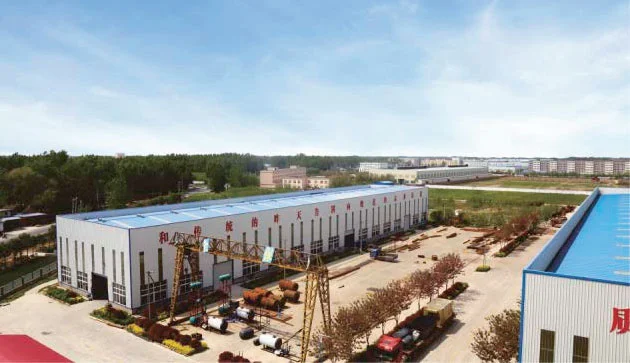
An electric steam boiler for a mill is a compact, welded, standards governed product, and the manufacturer decides how well the staging, controls and water spaces hold up over years of daily cycling. Henan Hengxin Boiler Co., Ltd. builds the LDR range as a licensed special equipment manufacturer certified under the ISO9001 and ISO14001 management systems and rated as a 3A credit enterprise, with certificates listed on the company honor page. The company offers draw based customisation and OEM production, so mills with unusual supply voltages, constrained plant corners, higher autoclave pressures or special control protocols can order the boiler matched to their building instead of rebuilding the building around the boiler. The full specification of the LDR electric heating boiler range is published on the product page for direct comparison against the sizing table above.
It can, and option A in the sizing example shows a single LDR0.7 covering both duties through a common header at about 85 percent load. The stronger arrangement for most mills is two smaller units with dedicated circuits, because the autoclave then draws its batch slugs without disturbing the humidification header, and a fault on one boiler leaves the mill half served rather than stopped. The right choice depends on how many autoclaves the plant runs and how much redundancy the production plan demands.
Plan on roughly 780 kWh of electricity per tonne of steam, which means the LDR0.5 draws about 390 kW and the LDR0.7 about 550 kW at full output. The transformer needs confirmed headroom above the connected load, each boiler needs a dedicated feeder, and staged element starting limits the inrush step by step. Mills paying demand charges should also sequence the staging and schedule autoclave batches so the electrical peak stays flat.
Yes, provided the steam is raised from properly softened boiler water with controlled dissolved solids and without volatile amine or odorous dosing chemicals, and provided a separator delivers dry saturated steam to the injection headers. Steam is simply water vapour, and dry steam condenses into the air stream without wetting the fibre or leaving residue. The water treatment rules in this article exist precisely so that the steam can be breathed and touched with confidence.
The immersed electric elements bring the boiler to working pressure within minutes from a cold start, far faster than any fuel fired unit that must warm a refractory lined furnace. The element banks switch in stages and the control holds stable operation down to about 30 percent of rated output, which covers the summer condition of a spinning mill, when humidification has faded away and only autoclave batches and laboratory steam remain.
A spinning mill asks its steam plant for clean dry steam in occupied buildings, sharp batch peaks from the autoclaves, deep seasonal modulation as the humidification load fades, and an electrical connection that is planned rather than improvised, and the LDR electric heating boiler answers all four: vertical six model range from 0.1 to 1.0 t/h at 0.4 or 0.7 MPa, 98 to 99 percent electrical efficiency with no flue, staged starting and stable 30 percent turn down, and a footprint that fits inside the mill building. Send the fresh air volumes, humidity targets and autoclave batch schedule of the mill to the Hengxin engineering team, and the reply will include the steam user table, the boiler configuration, the electrical supply figures and the cost comparison at local tariffs, together with the draw based customisation and OEM options of a licensed manufacturer certified under ISO9001 and ISO14001.