
Company News
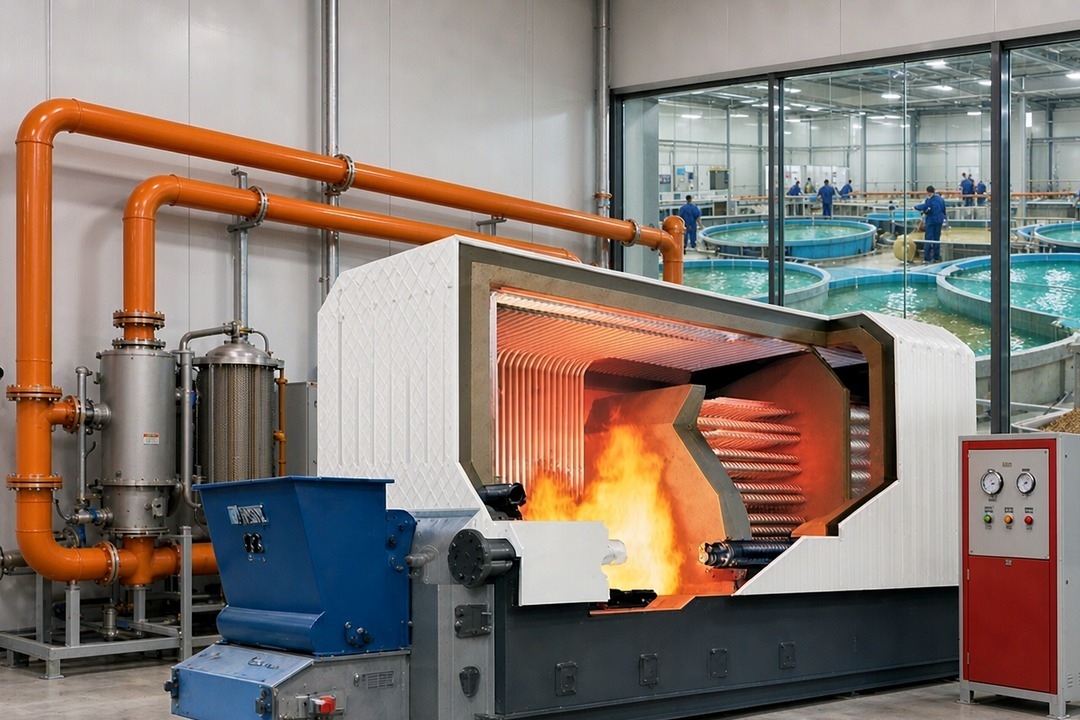
A shrimp or fish hatchery is one of the most temperature sensitive plants in the food chain. Broodstock tanks, incubation jars and larval rearing tanks hold living animals that cannot tolerate a temperature swing of more than one or two kelvin, algae and live feed rooms run on their own warmth day and night, and every liter of new water that enters the system must be brought from ambient to tank temperature before it ever touches the larvae. None of this needs steam at the point of use. What a hatchery actually needs is a large, steady flow of warm water held inside narrow temperature windows, delivered quietly around the clock through every season. That is exactly the duty profile of a biomass atmospheric hot water boiler: a grate fired boiler rated at zero gauge pressure, delivering 85 degree C supply water and 60 degree C return water at a declared efficiency of 83 percent or better, burning coal or biomass fuel.
For hatcheries located along tropical and subtropical coastlines, close to rice mills, saw mills and farm belts, biomass fuel adds a commercial argument on top of the technical one. Rice husk, wood chips and pellets are often priced well below diesel and LPG, and fuel is usually the largest controllable running cost of a hatchery after feed. This article is written for hatchery owners, aquaculture project engineers and purchasing teams. It maps the heat users of a typical shrimp hatchery, explains why the 85/60 atmospheric regime fits aquaculture duty, walks through a four step sizing method with a worked example, lists the full model range from 0.35 to 14 MW, and covers fuel consumption, boiler house layout, water discipline, maintenance and supplier qualifications.
Heat demand in a hatchery concentrates in a handful of stations, and each station holds its water inside a window set by biology rather than by comfort. The ranges below are indicative planning figures gathered from aquaculture practice; the culture protocol of the target species always takes precedence in a final design.
| Heat user | Typical service temperature | Notes |
|---|---|---|
| Broodstock holding tanks | 26 to 30 degrees C, continuous | The most valuable water in the plant; maturation rooms run day and night with minimal tolerance for dips |
| Incubation jars and hatching troughs | 28 to 31 degrees C | Egg stages are the most sensitive to swings; gentle, stable heating is essential |
| Larval rearing tanks | 28 to 31 degrees C | Daily water renewal of 20 to 50 percent must be reheated before entry |
| Algae culture and live feed rooms | 24 to 28 degrees C | Indoor rooms and tanks for algae, rotifers and artemia; artemia hatching baths hold 28 to 30 degrees C |
| New water preheating | from ambient 16 to 22 up to 30 degrees C | Seawater or brackish intake heated continuously ahead of the tank circuit |
| Building heating and dehumidification | 22 to 26 degrees C in winter | Radiators or air handling coils keep the halls warm and dry in the cold season |
| Domestic, kitchen and washdown | 45 to 60 degrees C | Staff areas, canteen and tank washdown stations fed from the same plant |
At zero gauge pressure water boils at 100 degrees C, and the boiler simply runs an open vented circuit with supply and return at 85 and 60 degrees C. For an aquaculture plant this brings four practical benefits. First, safety: the circuit never exceeds atmospheric pressure, which suits a wet, salt laden environment where plant rooms are crowded and operators are fish farmers rather than boiler attendants; in many regions an open vented hot water boiler below the regulated capacity line also sits outside the strictest inspection regime, although the local special equipment authority must always confirm the applicable rules. Second, temperature matching: 85/60 water is an ideal primary for plate heat exchangers that feed 28 to 31 degree C tank loops, so each tank station gets exactly the temperature its protocol demands. Third, buffering: the large water volume of a grate fired boiler smooths the frequent small draws of a hatchery without short cycling. Fourth, separation: because every culture loop passes through an exchanger, the boiler circuit water, which is treated with inhibitors and softened salts, never touches the larvae, and a leak in a tank coil cannot drain the boiler. The comparison below summarizes how the three common plant concepts behave at a hatchery.
| Plant concept | Medium at the tank edge | Control character | Practical fit for a hatchery |
|---|---|---|---|
| Small steam boiler | steam to jacketed tanks, condensate back | fast but harsh, flash risk on control valves | treated water near larvae is a hygiene risk; condensate system adds cost |
| Pressurized hot water boiler | hot water through exchangers | stable, wide load band | suits large plants, but brings the pressure vessel inspection regime |
| Atmospheric 85/60 boiler | hot water through exchangers | stable and gentle over plate exchangers | open vented, lowest plant room cost, best match to 28 to 31 degree C tanks |
Hatcheries cluster in coastal farm belts where rice husk, wood chips and pellets are usually available from suppliers within a short radius, while diesel and LPG must be hauled in and their prices track global markets. On a warm water load that runs every day of the year, the difference between an oil fired plant and a biomass fired plant compounds into a large share of the operating budget. A biomass grate boiler also turns the fuel story into a regional one: husk from nearby rice mills, chips from local saw mills, pellets from regional plants, with ash that can often be returned to farmland where local rules allow. The series is rated for coal and biomass together, so the fuel mix can follow the seasonal market instead of being locked to one commodity. The practical requirements are modest but real: a covered fuel store sized for two to three weeks of supply, a magnetic separator ahead of the grate, and a dust collector matched to local emission limits.
Step 1. List the heat users with their simultaneous demand: broodstock and larval tanks, new water preheating, algae and live feed rooms, winter space heating and ventilation, and domestic services.
Step 2. Apply a demand factor. Tank heating runs continuously, but preheating batches, washdown draws and kitchen use overlap only partly, and 0.8 is a realistic planning factor for a hatchery with continuous culture rooms.
Step 3. Add a margin of about 10 percent for distribution losses through the insulated mains and exchanger stations, then read the required boiler capacity.
Step 4. Check the load point. A boiler that lands at roughly 65 to 85 percent of rated capacity at the winter peak runs in its efficient band and keeps reserve for a planned expansion of the tank hall.
Assume a coastal shrimp hatchery with two larval rearing halls, a broodstock maturation wing, an algae and live feed block, and full winter heating in the coldest months. The heat demand of each station is estimated from the mass of water lifted through its temperature rise, taking the specific heat of water as 4.19 kJ per kilogram kelvin.
| Heat user | Basis | Connected demand (kW) |
|---|---|---|
| Broodstock and larval rearing tanks | continuous holding duty at 28 to 31 degrees C including tank losses | 350 |
| New water preheating | 25,000 kg/h heated from 18 to 30 degrees C | 350 |
| Algae culture and live feed rooms | room heating and small tank duty, continuous | 90 |
| Space heating and ventilation coils | winter peak across halls and maturation wing | 280 |
| Domestic, kitchen and washdown | 45 to 60 degrees C services | 70 |
| Connected total | 1,140 | |
| After demand factor 0.8 | 912 | |
| After 10 percent margin | about 1,003 |
A required output of about 1.0 MW points to a CDZL1.4-85/60-SCIII in the 1.4 MW frame, which carries the winter peak at about 72 percent load and leaves headroom for a planned second rearing hall. A CDZL2.1 would sit at about 48 percent load, which suits a hatchery whose expansion plan is firm. Where the culture protocol demands absolute continuity in the maturation rooms, the plant can be split or backed up as the options below show; the right choice depends on how the business weighs capital cost against biological risk.
| Option | Configuration | Winter peak load point | Comment |
|---|---|---|---|
| A | one CDZL1.4 | about 72 percent | lowest capital cost, no built in redundancy |
| B | two CDZL0.7 units | about 36 percent each | one unit can be inspected while the other keeps the broodstock wing warm |
| C | one CDZL2.1 | about 48 percent | room for a second rearing hall, higher capital cost |
| D | one CDZL1.4 plus standby electric heater | about 72 percent | cheap continuity insurance on the maturation loop |
In the warm season the same plant runs at a fraction of its rating on tanks, preheating and domestic duty alone, and the grate simply follows the supply temperature setpoint down. The same four step method transfers to any hatchery size: list the users, apply the factors, then check the load point of the nearest model.
The range spans three series on one technical platform. The CDZH hand fed boilers suit small hatcheries and remote sites where mechanized fuel handling is not justified, the CDZL chain grate boilers are the standard choice for continuous hatchery duty, and the CSZL double drum boilers extend the range to large integrated aquaculture estates that combine hatcheries with processing plants. All models share the zero gauge pressure rating, the 85/60 degree C design temperatures and the declared coal and biomass fuel band, with heat efficiency of 83 percent or better. The table below reflects the current published data.
| Model | Rated power (MW) | Pressure (MPa) | Outlet/return (degrees C) | Efficiency | Transport weight (kg) | Transport size L x W x H (mm) |
|---|---|---|---|---|---|---|
| CDZL0.35-85/60-SCIII | 0.35 | 0 | 85/60 | at or above 83% | 9000 | 3300 x 2000 x 2656 |
| CDZL0.7-85/60-SCIII | 0.7 | 0 | 85/60 | at or above 83% | 14500 | 4800 x 2150 x 2960 |
| CDZL1.4-85/60-SCIII | 1.4 | 0 | 85/60 | at or above 83% | 25000 | 5280 x 2380 x 3030 |
| CDZL2.1-85/60-SCIII | 2.1 | 0 | 85/60 | at or above 83% | 26000 | 5500 x 2420 x 3250 |
| CDZL2.8-85/60-SCIII | 2.8 | 0 | 85/60 | at or above 83% | 28000 | 6000 x 2500 x 3400 |
| CDZL4.2-85/60-SCIII | 4.2 | 0 | 85/60 | at or above 83% | 30000 | 7200 x 2600 x 3800 |
| CDZL5.6-85/60-SCIII | 5.6 | 0 | 85/60 | at or above 83% | 35000 | 7600 x 2800 x 4200 |
| CDZL7.0-85/60-SCIII | 7.0 | 0 | 85/60 | at or above 83% | 40000 | 8000 x 3200 x 5580 |
| CDZH0.35-85/60-SCIII | 0.35 | 0 | 85/60 | at or above 83% | 9000 | 3300 x 2000 x 2656 |
| CDZH0.7-85/60-SCIII | 0.7 | 0 | 85/60 | at or above 83% | 13000 | 4820 x 2150 x 2960 |
| CDZH1.4-85/60-SCIII | 1.4 | 0 | 85/60 | at or above 83% | 25000 | 5280 x 2380 x 3030 |
| CDZH2.1-85/60-SCIII | 2.1 | 0 | 85/60 | at or above 83% | 26000 | 5500 x 2420 x 3250 |
| CDZH2.8-85/60-SCIII | 2.8 | 0 | 85/60 | at or above 83% | 28000 | 6000 x 2500 x 3400 |
| CDZH4.2-85/60-SCIII | 4.2 | 0 | 85/60 | at or above 83% | 30000 | 7200 x 2600 x 3800 |
| CSZL4.2-85/60-SCIII | 4.2 | 0 | 85/60 | at or above 83% | 23000 | 10200 x 3200 x 5800 |
| CSZL5.6-85/60-SCIII | 5.6 | 0 | 85/60 | at or above 83% | 34000 | 11700 x 3500 x 5900 |
| CSZL7.0-85/60-SCIII | 7.0 | 0 | 85/60 | at or above 83% | 35000 | 11900 x 3200 x 6400 |
| CSZL10.5-85/60-SCIII | 10.5 | 0 | 85/60 | at or above 83% | 39000 | 12600 x 4600 x 6700 |
| CSZL14-85/60-SCIII | 14 | 0 | 85/60 | at or above 83% | 45000 | 13800 x 5200 x 8400 |
Because the boilers ship as substantial preassembled blocks, site erection on a prepared foundation is measured in weeks rather than months, which matters when the works must fit between two production cycles. Full technical data and options are published on the atmospheric biomass hot water boiler product page.
One megawatt hour of delivered heat at 83 percent efficiency requires about 4.34 GJ of fuel energy, which the table converts into mass terms for common fuels; the figures are indicative and move with moisture content, so procurement should always price fuel on its net heating value rather than on tonnage alone.
| Fuel | Typical net heating value | Consumption per MWh delivered at 83 percent |
|---|---|---|
| Wood pellets | about 17.0 MJ/kg | about 255 kg |
| Wood chips, about 30 percent moisture | about 13.5 MJ/kg | about 321 kg |
| Rice husk | about 14.5 MJ/kg | about 299 kg |
| Straw briquettes | about 15.0 MJ/kg | about 289 kg |
| Coal, about 5000 kcal/kg | about 20.9 MJ/kg | about 208 kg |
Budget planners multiply the peak hour figure by the annual culture calendar. A hatchery that runs the equivalent of 3,200 full load hours a year at an average delivered duty of about 1.0 MW consumes in the order of 3,200 MWh per year, which converts to roughly 815 tonnes of pellets or 1,030 tonnes of rice husk. A covered fuel yard holding two to three weeks of stock protects the hatch window against delivery delays, and because culture demand runs through the year, deliveries can be scheduled evenly instead of seasonally.
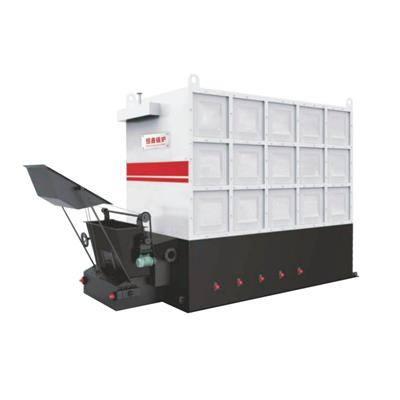
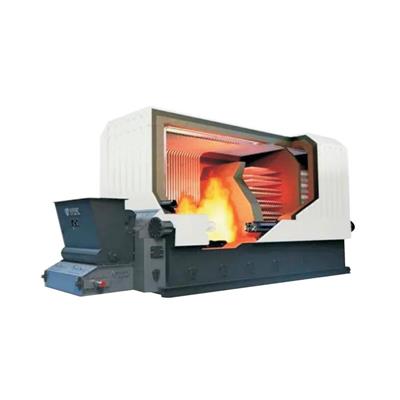
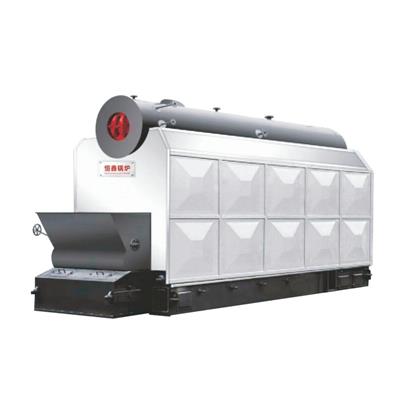
The series is built as a single drum, longitudinally arranged water fire tube boiler with a travelling grate. The left and right furnace walls carry the membrane water wall panels that absorb radiant heat, while threaded smoke tubes in the two wings of the furnace and in the drum form the convection bank. Three construction details earn their keep in a hatchery plant that never really stops. The arched tube plate changes the drum from a quasi rigid body into a quasi elastic one and reduces the stress that traditionally cracked tube plates on boilers of this type, while the smoke tubes leave the tube plate in a single return instead of two. A row of rising tubes along the drum bottom removes the stagnant zone where sludge would otherwise settle, so the drum bottom is washed by circulating water and protected against overheating. The threaded tubes stir the flue gas and raise the heat transfer coefficient, which is why the boiler reaches operating temperature quickly after a shutdown, a rhythm every hatchery facility team knows from the start of a new breeding cycle.
Inside the furnace, the octagonal wall and the outlet smoke window drop a first share of fly ash before the gas leaves the boiler, which lightens the duty of the dust collector behind it. The connected intelligent cloud platform reports operating state to the office, with automatic feedwater adjustment, high and low water alarms and over temperature protection supervising the circuit between shifts. Water discipline is still the cheapest insurance an open vented plant can buy: the system loses water by design through the vent and takes in make up continuously, so the make up water must be softened, and a daily check of hardness and pH takes minutes while protecting both the drum and the exchanger plates of the culture circuits.
A hatchery boiler plant has one requirement that factories do not: it sits next to living animals, and everything about its location and hygiene follows from that.
| Planning item | Practical guidance for a hatchery |
|---|---|
| Location and separation | Place the boiler house downwind of the culture halls and air intakes, with a washable wall between boiler room and tank halls; keep the fuel dust zone outside the hatchery hygiene perimeter |
| Fuel yard | Covered chip, husk or pellet store with front loader access or a silo with screw conveyor; a magnetic separator ahead of the grate protects the grate and the fire |
| Foundation | Reinforced concrete plinth sized to the transport weight of the chosen model, level within the supplier tolerance drawing |
| Primary circuit | Open expansion tank at the highest point, circulating pumps sized for the 85/60 duty, insulated mains to the exchanger stations with drain points |
| Exchanger stations | Plate exchangers beside each tank hall feed the 28 to 31 degree C loops; culture water and boiler water never mix, and every loop keeps its own circulation pump and control valve |
| Water treatment | Softener matched to the local water analysis, dosing for oxygen scavenging, and a sample cooler for daily hardness and pH checks |
| Flue path | Multi cyclone plus bag filter where local limits require, chimney height per the environmental approval, plume routed away from culture hall intakes |
| Ash handling | Covered ash bins under the grate discharge; husk and chip ash can often be returned to farmland where local rules allow |
| Controls | Grate speed linked to supply temperature, outdoor reset for the winter heating circuit, remote monitoring through the boiler cloud platform |
Hatchery outages are not like factory outages: a tank hall cools quickly, and a planned inspection must never coincide with a hatching window. The calendar below keeps the plant ready.
| Interval | Tasks for a hatchery boiler plant |
|---|---|
| Daily | Check water level and supply temperature, fuel stock at the hopper, drain the drum bottom, log water hardness and pH |
| Weekly | Inspect grate drive and sprockets, check dust collector differential pressure, clean strainers at the exchanger stations |
| Monthly | Test high and low water alarms and interlocks, verify calibration of tank loop sensors, exercise valves on standby circuits |
| Annual | Internal inspection scheduled into the off season between production cycles, refractory check, dust collector service, full shutdown maintenance |
Kept on this rhythm, the arched tube plate and single return smoke tube design address the cracking and efficiency problems that older grate boiler generations struggled with, and the plant stays ready for the moment a new batch of eggs enters the jars.
| Mistake | Why it hurts and what to do instead |
|---|---|
| Sizing only for tank holding duty | The new water preheating load and the winter heating load often exceed the tank duty itself; size the plant on the simultaneous winter peak, not on the average day |
| Mixing boiler water with culture water | Treated boiler water must never reach the tanks; every culture loop belongs behind a plate exchanger with its own pump and control valve |
| Deep night setback on tank circuits | Culture protocols do not forgive overnight dips; setback belongs on the building heating circuit only, while tank loops hold their window around the clock |
| Ignoring the salt laden air | Coastal humidity corrodes exposed steel and electronics; keep the boiler room dry and positive, protect the electrical cabinet, and inspect the flue path for corrosion every season |
| One boiler with no standby strategy | A single unit carries a biological risk; plan two smaller boilers, or at minimum a standby electric heater on the broodstock loop, and schedule inspections between hatch windows |
A hatchery heating plant is a long life asset, and the supplier behind it matters as much as the nameplate data. Buyers should verify that the manufacturer holds ISO 9001 and ISO 14001 certification, the special equipment manufacture license required for boiler production in its home jurisdiction, and a documented quality process from raw material through hydraulic test to factory acceptance; the certification overview on the company honors and certificates page lists these credentials. Where the project needs a non standard layout, a special fuel feeding system, or a plant matched to an existing building, the manufacturer builds to customer drawings as an OEM partner, and the same platform logic supports custom power ratings and control packages. Reference projects across the industries served, from food plants to district heating, are collected on the boiler application overview, and an aquaculture project benefits from the same engineering discipline: a stated duty, a stated fuel, and a stated efficiency.
Yes, and that is the normal arrangement. The boiler runs one 85/60 primary loop, and plate exchanger stations split it into the 28 to 31 degree C tank circuits, the algae rooms, the heating coils and the domestic services. Size the plant on the simultaneous winter peak, when tank duty, preheating and space heating overlap, and let the heating circuit take the outdoor reset while the tank loops hold their own windows.
Steam at the tank edge is difficult to control gently, and any condensate or treated water that reaches a culture tank can harm the larvae. An 85/60 loop behind a plate exchanger gives stable, low differential control of the tank temperature, needs no pressure bearing inspection regime in most jurisdictions, and keeps the treated boiler water physically separated from the culture water. Confirm the local inspection rules with the authority before the design is frozen.
The series is rated for coal and biomass together, so the choice follows the local market. Wood pellets are the cleanest and most consistent, rice husk is often the cheapest in rice growing coastal belts, and wood chips work well when a steady supplier can hold moisture near 30 percent or below. Whatever the fuel, keep it covered, screen it before the grate, and price it on net heating value per tonne rather than on tonnage alone.
The thermal mass of the tank water buffers short interruptions, but a hall of small tanks can drift out of its window within hours in cold weather. That is why the sizing section recommends either two smaller boilers that share the duty or a standby electric heater on the most sensitive loop, together with alarm routing to the cloud platform so the night crew can act before the water cools.
Henan Hengxin Boiler Co. builds the full atmospheric biomass hot water range from 0.35 to 14 MW, supports drawing based customization and OEM cooperation, and ships preassembled blocks that cut site erection to weeks. Send the hatchery layout, the target species and production plan, the local fuel options and the ambient design temperatures, and the engineering team will return a sized proposal with the recommended model, an exchanger station schedule and a fuel budget for the local market.