
Company News
A resort property is a small city of comfort. Guests expect hot showers at any hour, kitchens run from early breakfast to late dinner, laundries wash tonne after tonne of linen, spa pools hold their temperature day and night, and in the heating season the guest wings and public halls stay warm without a single complaint reaching the front desk. None of these services needs steam at the point of use. What the property actually needs is large volumes of water held inside narrow temperature windows, delivered quietly and continuously, around the clock, in every season. That is exactly the duty profile of a biomass pressurized hot water boiler: a grate fired boiler that delivers 115 degree C supply water and 70 degree C return water at a rated pressure of 1.0 MPa, burning coal or biomass fuel at a declared efficiency of 83 percent or better.
For properties located in farm belts or forest regions, biomass fuel adds a commercial argument on top of the technical one. Wood chips, pellets and agri residues are often priced well below oil and LPG, and a hotel that burns locally sourced fuel can present that choice to its own guests as part of a sustainability story. This article is written for hotel and resort owners, facility engineers and project purchasing teams. It maps the hot water users of a resort property, explains why the 115/70 pressurized regime fits hospitality duty, walks through a four step sizing method with a worked example for a 300 room resort, lists the full model range from 0.35 to 14 MW, and covers fuel consumption, boiler house layout, water discipline, emissions and supplier qualifications.
Heat demand in a hotel concentrates in a handful of stations, and each station holds the water in a window that comfort or hygiene demands. The figures below are indicative planning ranges gathered from hospitality practice; the nameplate data of the installed kitchen equipment, laundry machines and spa systems always takes precedence in a final design.
| Hot water user | Typical service temperature | Notes |
|---|---|---|
| Guest room domestic hot water | 50 to 60 degrees C at the tap | Storage calorifiers hold the draw off temperature; morning and evening peaks dominate the day curve |
| On premises laundry | 60 to 85 degrees C by cycle | Washer extractor hot fills and tunnel washer zones; the largest single daytime industrial load |
| Kitchen and dishwashing | 60 to 80 degrees C | Pot wash and dish machine final rinse, fed through a tempered ring main |
| Spa pools and wellness area | 35 to 40 degrees C pools, 70 to 90 degrees C loops | Pool water reheating and air handling coils run continuously, even at low occupancy |
| Swimming pool hall ventilation | Supply air 28 to 32 degrees C | Dehumidification coils take warm water year round to protect the building fabric |
| Space heating and air handling | 60 to 70 degrees C | Guest wings, lobby, restaurants and back of house areas in the heating season |
| Housekeeping and back of house | 55 to 60 degrees C | Cleaning stations, staff areas and canteen, fed through the domestic ring main |
At atmospheric pressure water boils at 100 degrees C, so a supply temperature of 115 degrees C is only possible in a pressurized circuit, which is why the boiler is rated at 1.0 MPa. The pressurized primary loop then feeds plate heat exchangers beside each station, and the secondary side runs at the exact temperature the station wants. The arrangement brings three practical benefits to a resort. First, a 45 kelvin temperature difference between supply and return means smaller mains, smaller pumps and fewer expansion facilities than a low temperature circuit of the same duty, which matters in a property where pipe routes run between buildings. Second, an exchanger with a comfortable approach turns 115 degree C primary water into steady 60 degree C domestic water and 70 to 90 degree C laundry water without any steam being made, so there is no flash steam venting near guest areas and no condensate return losses to chase. Third, the exchangers separate the boiler circuit from the domestic side, which simplifies hygiene management because the primary water never touches the taps. In the heating season the same primary loop serves the wing heating circuits through mixing or exchanger stations, so one boiler carries the whole property through the year.
Step 1. List the hot water users with their simultaneous demand: guest room domestic water, laundry, kitchen, spa and pool services, heating ventilation and back of house services.
Step 2. Apply a demand factor. Guest draw off peaks, laundry batches and kitchen cycles overlap only partly, and 0.7 is a realistic planning factor for a resort with on premises laundry and a spa.
Step 3. Add a margin of about 10 percent for distribution losses through the insulated mains and exchanger stations, then read the required boiler capacity.
Step 4. Check the load point. A boiler that lands at roughly 65 to 85 percent of rated capacity at winter peak runs in its efficient band and keeps reserve for a planned wing extension.
Assume a resort with 300 guest rooms in two wings, an on premises laundry, three restaurants, a spa with two pools, and full winter heating in both wings and the public areas. The heat demand of each station is estimated from the mass of water lifted through its temperature rise, taking the specific heat of water as 4.19 kJ per kilogram kelvin.
| Hot water user | Basis | Connected demand (kW) |
|---|---|---|
| Guest room domestic hot water | 10,000 kg/h heated from 15 to 55 degrees C | 466 |
| On premises laundry | 4,000 kg/h heated from 15 to 70 degrees C | 256 |
| Kitchen and dishwashing | 2,000 kg/h heated from 15 to 60 degrees C | 105 |
| Spa pools and pool hall air handling | continuous reheat duty at low season | 500 |
| Space heating, winter peak | two guest wings, lobby and public areas | 900 |
| Connected total | 2,227 | |
| After demand factor 0.7 | 1,559 | |
| After 10 percent margin | about 1,715 |
A required output of about 1.7 MW points to a DZL2.8-1.0/115/70-SCIII in the 2.8 MW frame, which carries the winter peak at about 61 percent load and leaves headroom for the planned second wing of 40 rooms. A DZL2.1 at 2.1 MW would sit above 80 percent load at winter peak, which is workable but leaves little reserve, so it suits a property whose expansion plan is firmly closed. Where the operator values continuity above capital economy, the duty splits across two smaller units, for example a pair of DZL1.4 boilers, so that one can be taken out for the statutory internal inspection while the other carries the property; the price is a second foundation, flue and set of pumps. In summer the same DZL2.8 runs at a fraction of its rating on domestic water, laundry and spa duty alone, and the grate simply follows the supply temperature setpoint down. The same four step method transfers to any property size: list the users, apply the factors, then check the load point of the nearest model.
The declared design fuel of the series covers coal and biomass together, which matters at a resort because fuel markets shift with the seasons and with the tourist calendar. Wood pellets are the cleanest and most consistent choice where the region supplies them, wood chips and agri pellets often come from the surrounding farm and forest belt at attractive prices, and coal remains a fallback where local permits still allow it. One megawatt hour of delivered heat at 83 percent efficiency requires about 4.34 GJ of fuel energy, which the table converts into mass terms for common fuels; the figures are indicative and move with moisture content.
| Fuel | Typical net heating value | Consumption per MWh delivered at 83 percent |
|---|---|---|
| Wood pellets | about 17.0 MJ/kg | about 255 kg |
| Wood chips, about 30 percent moisture | about 13.5 MJ/kg | about 321 kg |
| Rice husk | about 14.5 MJ/kg | about 299 kg |
| Straw briquettes | about 15.0 MJ/kg | about 289 kg |
| Coal, about 5000 kcal/kg | about 20.9 MJ/kg | about 208 kg |
Budget planners multiply the peak hour figure by the annual occupancy profile to size the fuel yard. A resort running the equivalent of 5,000 full load hours a year at an average of 1.2 MW consumes in the order of 1,550 tonnes of pellets or 1,950 tonnes of chips per year, so covered storage for two to three weeks of supply is a normal starting point for the yard design, sized so that deliveries never coincide with full occupancy weekends.
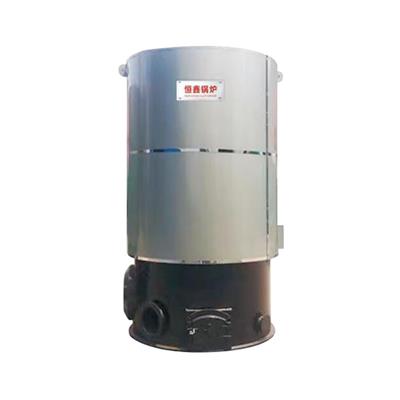
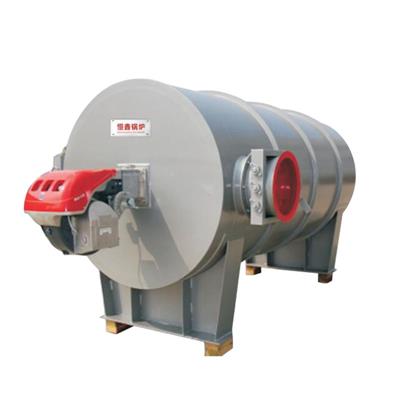
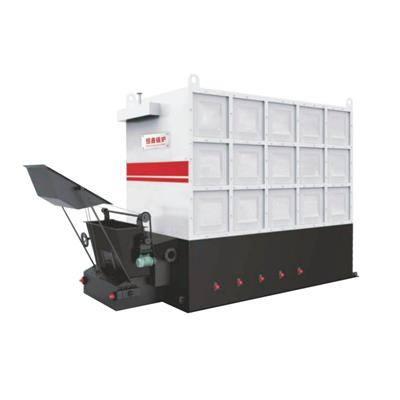
The series is built as a single drum, longitudinally arranged water fire tube boiler with a travelling grate. The left and right furnace walls carry the membrane water wall panels that absorb radiant heat, while threaded smoke tubes in the two wings of the furnace and in the drum form the convection bank. Three construction details earn their keep in hospitality service. The arched tube plate changes the drum from a quasi rigid body into a quasi elastic one and reduces the stress that traditionally cracked tube plates on boilers of this type, while the smoke tubes leave the tube plate in a single return instead of two. A row of rising tubes along the drum bottom removes the stagnant zone where sludge would otherwise settle, so the drum bottom is washed by circulating water and protected against overheating. The threaded tubes themselves stir the flue gas and raise the heat transfer coefficient, which is why the boiler reaches operating temperature quickly after a quiet shoulder season, a rhythm every resort facility team knows well.
Inside the furnace, the octagonal wall and the outlet smoke window drop a first share of fly ash before the gas leaves the boiler, which lightens the duty of the dust collector behind it. The compact overall format keeps the boiler house footprint modest, and the connected intelligent cloud platform reports operating state to the facility office, with automatic feedwater adjustment, high and low water alarms and overpressure protection supervising the circuit between shifts. A pressurized hot water circuit forgives less than an open vented one, so water discipline is the cheapest insurance a property can buy: the closed volume means any hardness that enters stays there, so make up water must be softened and the system kept tight, with a daily check of hardness, pH and inhibitor level taking minutes and protecting both the drum and the exchanger plates. Planned tasks follow a simple calendar.
| Interval | Tasks for a hotel boiler plant |
|---|---|
| Daily | Check level and pressure gauges, fuel stock at the hopper, drain the drum bottom, log water hardness and pH |
| Weekly | Inspect grate drive and sprockets, check bag filter differential pressure, clean strainers at the exchanger stations |
| Monthly | Exercise safety valves, test alarms and interlocks, verify calibration of supply temperature sensors |
| Annual | Statutory internal inspection scheduled into the low season, refractory check, bag filter tube service, full shutdown maintenance |
Kept on this rhythm, the arched tube plate and single return smoke tube design address the cracking and efficiency problems that older grate boiler generations struggled with, and the plant stays ready for the morning ramp when the kitchen, laundry and heating circuits come up together.
The range spans three series on one technical platform. The DZH hand fed boilers suit small properties and seasonal lodges, the DZL chain grate boilers are the standard choice for continuous resort duty, and the SZL double drum boilers extend the range to large resort complexes and mixed development districts. All models share the 1.0 MPa rating, the 115/70 degree C design temperatures and the declared coal and biomass fuel band.
| Model | Rated power (MW) | Pressure (MPa) | Outlet/return (degrees C) | Efficiency | Transport weight (kg) | Transport size L x W x H (mm) |
|---|---|---|---|---|---|---|
| DZH0.35-1.0/115/70-SCIII | 0.35 | 1.0 | 115/70 | at or above 83% | 9000 | 3300 x 2000 x 2656 |
| DZH0.7-1.0/115/70-SCIII | 0.7 | 1.0 | 115/70 | at or above 83% | 13000 | 4820 x 2150 x 2960 |
| DZH1.4-1.0/115/70-SCIII | 1.4 | 1.0 | 115/70 | at or above 83% | 25000 | 5280 x 2380 x 3030 |
| DZH2.1-1.0/115/70-SCIII | 2.1 | 1.0 | 115/70 | at or above 83% | 26000 | 5500 x 2420 x 3250 |
| DZH2.8-1.0/115/70-SCIII | 2.8 | 1.0 | 115/70 | at or above 83% | 28000 | 6000 x 2500 x 3400 |
| DZH4.2-1.0/115/70-SCIII | 4.2 | 1.0 | 115/70 | at or above 83% | 30000 | 7200 x 2600 x 3800 |
| DZL0.35-1.0/115/70-SCIII | 0.35 | 1.0 | 115/70 | at or above 83% | 11000 | 3300 x 2000 x 2656 |
| DZL0.7-1.0/115/70-SCIII | 0.7 | 1.0 | 115/70 | at or above 83% | 14500 | 4820 x 2150 x 2960 |
| DZL1.4-1.0/115/70-SCIII | 1.4 | 1.0 | 115/70 | at or above 83% | 25000 | 5280 x 2380 x 3030 |
| DZL2.1-1.0/115/70-SCIII | 2.1 | 1.0 | 115/70 | at or above 83% | 26000 | 5500 x 2420 x 3250 |
| DZL2.8-1.0/115/70-SCIII | 2.8 | 1.0 | 115/70 | at or above 83% | 28000 | 6000 x 2500 x 3400 |
| DZL4.2-1.0/115/70-SCIII | 4.2 | 1.0 | 115/70 | at or above 83% | 30000 | 7200 x 2600 x 3800 |
| DZL5.6-1.0/115/70-SCIII | 5.6 | 1.0 | 115/70 | at or above 83% | 35000 | 7600 x 2800 x 4200 |
| DZL7.0-1.0/115/70-SCIII | 7.0 | 1.0 | 115/70 | at or above 83% | 40000 | 8000 x 3200 x 5580 |
| SZL4.2-1.0/115/70-SCIII | 4.2 | 1.0 | 115/70 | at or above 83% | 23000 | 10200 x 3200 x 5800 |
| SZL5.6-1.0/115/70-SCIII | 5.6 | 1.0 | 115/70 | at or above 83% | 34000 | 11700 x 3500 x 5900 |
| SZL7.0-1.0/115/70-SCIII | 7.0 | 1.0 | 115/70 | at or above 83% | 35000 | 11900 x 3200 x 6400 |
| SZL10.5-1.0/115/70-SCIII | 10.5 | 1.0 | 115/70 | at or above 83% | 39000 | 12600 x 4600 x 6700 |
| SZL14-1.0/115/70-SCIII | 14 | 1.0 | 115/70 | at or above 83% | 45000 | 13800 x 5200 x 8400 |
Because the boilers ship as substantial preassembled blocks, site erection on a prepared foundation is measured in weeks rather than months. Full technical data and options are published on the pressurized biomass hot water boiler product page.
A resort boiler plant has one requirement that factories do not: it must stay invisible to the guest experience. That shapes the layout decisions long before the foundation is poured.
| Planning item | Practical guidance for a resort property |
|---|---|
| Location and separation | Place the boiler house at the service end of the site, downwind of guest wings, pool decks and intakes, screened by planting or service buildings; keep noise sources away from suite windows |
| Fuel yard | Covered pellet or chip store with front loader access or a silo with screw conveyor; position delivery access away from guest arrival routes, with a magnetic separator ahead of the grate |
| Foundation | Reinforced concrete plinth sized to the transport weight of the chosen model, level within the supplier tolerance drawing |
| Primary circuit | Pressurized expansion vessel and make up unit sized for the 115/70 system, safety valves set to match the 1.0 MPa rating, insulated mains with drain points between buildings |
| Exchanger stations | Plate exchangers with circulation pumps beside the domestic water storage, laundry, kitchen ring, spa plant room and wing heating circuits, each with control valves holding the secondary temperature |
| Water treatment | Softener matched to the local water analysis, deaeration or oxygen scavenger dosing, and a sample cooler for daily hardness and pH checks |
| Flue path | Bag filter with twin tower desulfurization where local limits require, chimney height per the environmental approval, routing the plume away from terraces and pool areas |
| Ash handling | Covered ash bins under the grate discharge; biomass ash is light and can often be returned to farmland or gardens where local rules allow |
| Controls | Grate speed linked to supply temperature, weather compensation for the wing heating circuits, remote monitoring through the boiler cloud platform |
Most trouble in hospitality boiler projects traces back to a handful of avoidable errors made during sizing and layout.
| Mistake | What happens | How to avoid it |
|---|---|---|
| Sizing on room count alone | The boiler is selected from a rule of thumb per room and ends up oversized, cycling at low load outside the efficient band | Build the load table station by station, as in the worked example, and apply demand factors |
| Ignoring the laundry and spa peaks | The morning ramp from guest showers, laundry batches and kitchen start overlaps and the plant falls behind | Count laundry and spa as named users with their own flow and temperature basis |
| Under specifying fuel handling | Wet chips bridge in the hopper and the duty manager becomes a fuel handler every morning | Match the hopper, conveyor and storage to the wettest fuel the region delivers in the rainy season |
| Skipping expansion vessel sizing | The pressurized circuit swings on pressure and nuisance trips interrupt guest hot water | Size the pressurized expansion and make up unit for the full system volume at 115/70 |
| No plan for the inspection window | The statutory internal inspection closes the only boiler and guests lose hot water | Plan the annual inspection into the low season, or split the duty across two units or a buffer tank |
Biomass fuel carries little sulfur, so switching a resort from an oil fired plant to a grate fired biomass boiler lowers the sulfur burden of the flue gas from the first season, an argument that also supports the property environmental reporting many resort groups now publish. Dust is the parameter that regulators watch near hospitality and residential zones, and the series addresses it in layers: the octagonal furnace wall and outlet smoke window settle fly ash inside the boiler, a bag filter catches the bulk of the remainder, and a twin tower desulfurization stage is added where local permits require it. Chimney height and plume routing deserve particular care on a resort site, because a plume drifting over a pool deck or a terrace is a guest experience problem as much as a technical one. On the compliance side, a 1.0 MPa boiler is pressure equipment and is manufactured under the special equipment regulations that govern such products; the operator registers the unit and arranges statutory periodic inspection under the rules of its own jurisdiction, which differ by country and capacity class. Purchasing teams should confirm the local classification for a 1.0 MPa hot water boiler in the chosen size before ordering, and the supplier documentation pack supports that registration.
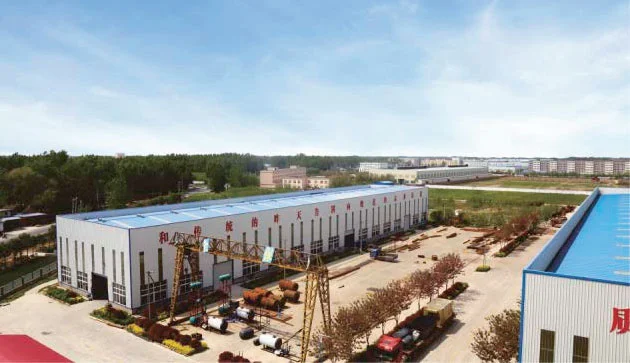
Henan Hengxin Boiler Co., Ltd. manufactures the series under an ISO9001 quality management system and an ISO14001 environmental management system, holds the special equipment manufacture license required in China, and is rated a 3A credit enterprise. The certificates and licenses are published on the certifications and honors page so procurement teams can verify them directly. The factory brings four decades of boiler manufacturing, a production base of 660,000 square meters, 336 production machines and a catalog of more than 300 models.
Beyond the standard models, the factory supports drawing based customization and OEM work: exchanger station packages matched to an existing plant room, fuel handling adapted to the pellets or chips available in the region, layout drawings coordinated with a resort master plan, and export packing arranged for container shipment. Service is structured around the purchasing decision as well: technical consultation within 30 minutes, a clear proposal within 2 hours, engineer dispatch to the site in 24 to 72 hours where required, free maintenance for 12 months after shipment, and delivery windows of 15 days for smaller boilers, 20 days for the middle class and 35 days above. Hotels, schools and hospitals share the same heat profile of continuous domestic hot water plus seasonal heating, and buyers can see reference scenarios on the hospital, school and hotel application page.
Yes, and that is the normal arrangement for a resort. In winter the primary 115/70 loop serves the wing heating circuits and the domestic stations together, and the worked example sizes the boiler on that combined winter peak. In summer the heating circuits close and the boiler follows domestic water, laundry and spa duty at a fraction of rated output, with the grate and combustion air tracking the supply temperature setpoint down. The control system handles the seasonal shift automatically; what the operator should plan is the low season maintenance window described in the operating calendar.
The pressurized 115 degree C supply widens the temperature difference across the circuit, which reduces pipe and pump sizes for the same duty, a real saving on a resort site where mains run between buildings. It still delivers 50 to 60 degree C domestic water through exchangers with a comfortable approach. An atmospheric 95/70 system can reach the same secondary temperatures only with a small approach, which means larger exchangers and higher flow rates. The tradeoff is that a pressurized system is pressure equipment with the associated registration and periodic inspection duties, which the documentation pack supports.
The grate and combustion fan are the main noise sources, so the practical answer is a separate boiler house at the service end of the site, downwind of guest wings and outdoor areas, with fuel deliveries routed away from arrival paths. Within the boiler house itself the plant runs at normal industrial noise levels, and the compact format keeps the building modest. Properties that must place the plant near occupied buildings usually add acoustic treatment to the fan intake and the door facing the guest side rather than moving the boiler.
Delivery of the boiler itself follows the size class, with shorter windows for smaller units and around 35 days for the largest frames, plus site erection, piping and commissioning on a prepared foundation. Because the boilers ship as preassembled blocks and the layout drawings accompany the quotation, the civil work and the boiler manufacturing can proceed in parallel, and the exchanger stations, fuel yard and mains between buildings are usually the site work that decides the start date. Properties with a fixed reopening date after a low season renovation should anchor the commissioning date to that reopening and work backward.
Sizing a resort hot water plant comes down to counting the guest rooms, laundry, kitchen, spa and heating circuits, respecting the demand factors between them and landing the boiler at a sensible load point on the fuel the region supplies. Send Henan Hengxin Boiler Co., Ltd. the room count and occupancy profile, the station list with temperatures, the local fuel analysis and the site water report, and the engineering team will return a capacity proposal, an indicative fuel consumption table and a boiler house layout. From the 0.35 MW DZH0.35 for a boutique lodge to the 14 MW SZL14 for a large resort complex, the biomass pressurized hot water boiler series turns locally available fuel into the steady 115/70 degree C circuit that keeps guest showers hot, laundries moving and winter wings warm, season after season.