
Company News
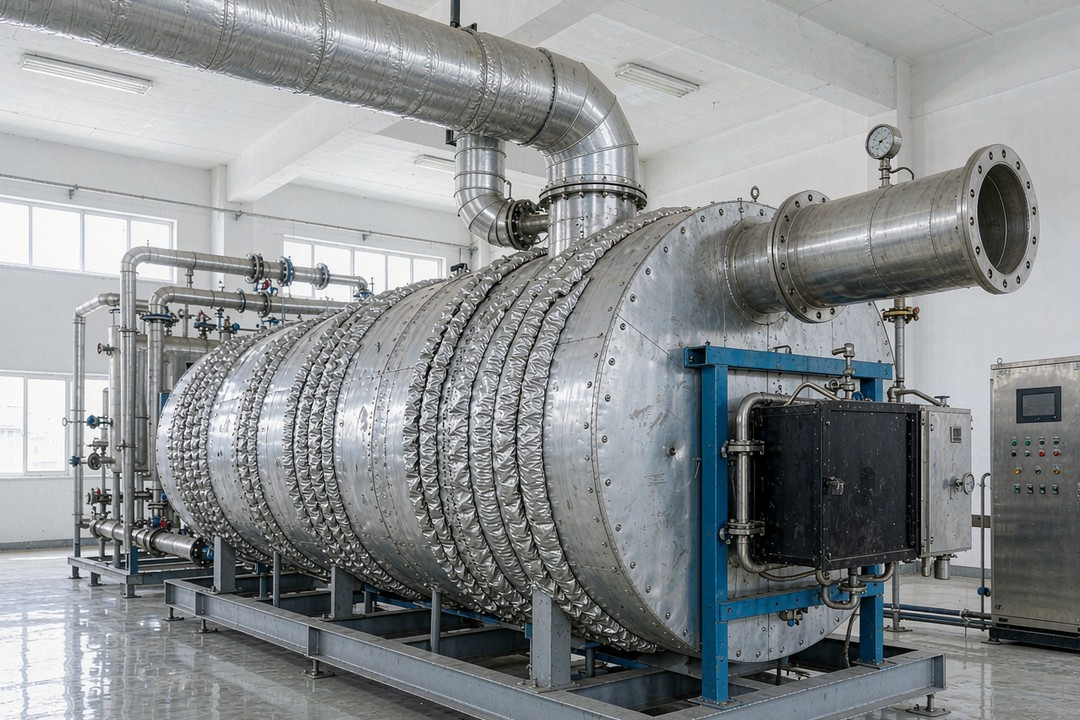
Steam is the backbone of modern food and beverage manufacturing. From blanching and cooking to pasteurisation, sterilisation, concentration and clean-in-place (CIP), almost every production line depends on a steady supply of dry, clean steam at a predictable pressure. For plants that run on natural gas, light oil or heavy oil, the SZS oil/gas fired boiler has become one of the most widely specified water tube packages in the industry. This article explains how the design works, why food factories favour it, which specifications matter during selection, and how to evaluate a supplier before placing an order.
SZS is a Chinese classification code for a double-drum, longitudinal, water tube steam boiler. The letters describe the mechanical arrangement rather than a single model: the furnace and the convection bank are formed by tubes, and the unit carries two drums, an upper steam drum and a lower mud drum, connected by banks of riser and downcomer tubes.
Combustion takes place inside a membrane-wall furnace that is fully water cooled. Hot flue gas then travels through the convection tube bundle, an economiser and, in many configurations, an air preheater before leaving the stack. Because the water content is lower than in a fire tube shell boiler of the same capacity, the SZS responds quickly to load changes and reaches full output from a cold start in a relatively short time.
Typical capacity ranges span from roughly 4 t/h up to 40 t/h and beyond, with design pressures commonly between 1.25 MPa and 2.5 MPa and saturated steam temperatures around 194 °C to 225 °C. Higher pressure and superheated variants are available for special processes. Hengxin Boiler builds the full range of SZS oil/gas fired boiler units and can adapt the arrangement to a specific plant layout.
Food production is rarely a flat load. A plant may run a continuous pasteuriser at a steady 6 t/h, then add a 3 t/h surge when a cooking vessel refills or a CIP cycle starts. A fire tube boiler with a large water volume absorbs those swings slowly and can overshoot on pressure. The SZS design, with its smaller water inventory and direct tube cooling of the furnace, follows the curve more closely. That means less steam blowing off through the safety valve and tighter pressure control at the header.
Where steam contacts product directly, quality matters. The SZS drum arrangement provides generous steam space and effective internal separation, so the delivered steam is dry and low in carryover. Combined with proper feedwater treatment and blowdown control, this helps a plant meet the steam purity expectations of food safety audits. In direct injection applications, food grade boiler treatment chemicals and a well controlled drum water level are essential regardless of boiler type.
The tube layout exposes a large heat transfer surface to the flue gas path. With an economiser and an air preheater, thermal efficiency commonly reaches 92 percent and above on gas, and comparable figures on light oil. Over a plant running 6,000 hours a year, each percentage point of efficiency translates into a meaningful reduction in annual fuel spend, which is usually the single largest variable cost in the boiler house.
Water tube boilers are taller than shell boilers of the same rating and need more headroom, but they free up floor area because the pressure parts rise vertically rather than stretching horizontally. In a retrofit where the boiler house is already tight, that geometry often decides the choice.
Across the sector, steam is used for both process heat and sanitation. The table below summarises common duties and the boiler capacity range that normally suits them. Detailed application notes are grouped on our food and beverage applications page.
| Process Duty | Typical Steam Demand | Usual Capacity Range | Notes |
|---|---|---|---|
| Blanching and scalding | Continuous, moderate | 4 to 10 t/h | Stable pressure important for consistent product texture |
| Cooking and retort kettles | Batch, cyclic | 6 to 15 t/h | Fast response reduces pressure droop at batch start |
| Pasteurisation and UHT | Continuous, high quality steam | 8 to 20 t/h | Dry steam and low carryover are essential |
| Concentration and evaporation | Continuous, high volume | 10 to 30 t/h | Multi-effect sets benefit from high efficiency |
| Clean-in-place (CIP) | Short, sharp peaks | Shared with process load | Header sizing and a small buffer capacity help |
| Bottling and canning lines | Continuous plus peaks | 8 to 25 t/h | Redundancy is often required for line availability |
| Dairy drying towers | Continuous, high volume | 15 to 40 t/h | Air preheater recovery pays back quickly |
| Edible oil refining | Continuous, medium pressure | 10 to 25 t/h | Higher design pressure options may be needed |
The same water tube platform is also widely used in textile dyeing, paper making, chemical processing, district heating and central heating networks. In these plants the duty differs but the selection logic does not: match the boiler to the load profile, the fuel, and the steam quality requirement.
Procurement documents for food industry boilers tend to converge on the same set of parameters. Confirming each one early avoids costly revisions later.
| Parameter | Common Range | Why It Matters |
|---|---|---|
| Rated evaporation | 4 to 40 t/h | Must cover the peak simultaneous load with margin |
| Rated steam pressure | 1.25, 1.6, 2.5 MPa | Determines process temperature and safety valve setting |
| Saturated steam temperature | 194 to 225 °C | Linked directly to the selected pressure |
| Feedwater temperature | 20 to 105 °C | Affects economiser sizing and efficiency calculation |
| Fuel | Natural gas, LPG, light oil, heavy oil | Sets the burner, furnace volume and gas path design |
| Thermal efficiency | 92 to 96 percent | Drives annual fuel cost and carbon reporting |
| NOx emission | 30 to 80 mg/Nm3 typical range | Local permits may demand low NOx burners |
| Control mode | Automatic, PLC plus touchscreen | Interfaces with plant SCADA and energy meters |
| Design standard | ASME, EN, GB or equivalent | Determines inspection and certification route |
| Boiler efficiency guarantee | Tested at specified load | Verify the reference fuel and ambient conditions |
Natural gas remains the first choice in most regions because it is clean, easy to meter and produces low emissions. Light oil such as diesel is a common standby, and dual fuel burners that switch between gas and oil give plants a hedge against supply interruption. Heavy oil is still used in some markets, but it requires heating, filtration and more frequent maintenance.
Three efficiency measures are worth evaluating at the specification stage. First, a flue gas economiser that preheats feedwater using exhaust gas. Second, an air preheater that raises combustion air temperature and improves furnace conditions. Third, a condensing tail end unit that recovers latent heat from the flue gas, which is most effective when the return water temperature is low. Each of these adds capital cost but shortens payback when the plant runs many hours per year.
Boiler selection is not a pure commodity purchase. The pressure parts, welds, controls and documentation all affect safety and long term reliability. When comparing quotations, ask for the following.
Manufacturing licence and pressure vessel certification for the specific design code required by your authority.
Third party inspection reports and material certificates for the drum, tubes and headers.
Verified efficiency test data, including the fuel specification and load point used.
Burner brand and its own certification, plus spare parts availability in your region.
Reference installations of similar capacity and fuel operating in food or beverage service.
Clear scope boundaries: who supplies the feedwater pump, deaerator, water softener, valves, insulation and electrical panel.
Lead time, shipping method, and site supervision arrangements for erection and commissioning.
Training for boiler operators and a documented maintenance schedule.
An OEM relationship adds value where a plant has non standard constraints. Hengxin Boiler manufactures water tube, fire tube, thermal fluid heater, hot air furnace and electric heating boiler ranges, and accepts custom development from customer drawings. That breadth makes it easier to keep one supplier responsible for a mixed boiler house.
Water tube boilers are usually shipped in sections or in skid mounted modules to suit road and container limits, then assembled on site. A typical sequence is foundation and steelwork, drum and tube bundle erection, refractory and insulation, burner and fan installation, piping and electrical connection, hydraulic test, and finally combustion tuning and performance testing.
Commissioning should include a documented combustion setup across the load range, a safety interlock functional test, a water level control check, and a load test at the guaranteed efficiency point. Ask for the commissioning report to be handed over with the operation and maintenance manual, the pressure vessel certificate, and the spare parts list.
After handover, a preventive maintenance plan covering water chemistry, blowdown, burner servicing, flue gas analysis and tube inspection will keep the unit running at design efficiency for its full service life.
WNS is a horizontal fire tube design in which flue gas passes through tubes surrounded by water. SZS is a water tube design in which water and steam pass through tubes surrounded by flue gas, arranged around a water cooled furnace between two drums. SZS units generally suit larger capacities and faster load changes, while WNS units are more compact for smaller steam or hot water duties.
Most medium sized food plants with cooking, pasteurisation and CIP duties land between 8 t/h and 20 t/h. The correct figure comes from a load study that lists every steam user, its design consumption and its simultaneity factor. Sizing on the sum of nameplate figures alone usually produces an oversized boiler.
Yes. Dual fuel burners that run on natural gas as the primary fuel and light oil as standby are common. The boiler pressure parts stay the same; the burner, fuel train, valves and control logic are selected for both fuels, and the changeover is managed by the burner management system.
With an economiser and air preheater, a well matched unit typically achieves 92 to 96 percent thermal efficiency on natural gas, depending on feedwater temperature, excess air and load point. Efficiency should always be quoted with the fuel specification and test load, because values taken at full load without auxiliary power accounted for can be optimistic.
For a standard capacity unit, manufacturing commonly takes several weeks after drawing approval, followed by shipping and site erection. Total project duration depends heavily on foundation readiness, permit inspections and the availability of a licensed erection contractor. Confirming these dates in the contract protects the project schedule.
If you are planning a new boiler house or replacing an ageing unit, the most useful starting point is a short technical conversation about the load profile, fuel availability, steam quality requirement and space constraints. Our engineering team can review your drawings, propose a suitable SZS configuration, and provide a full scope quotation. Please contact the engineering team with your duty requirements, or browse the complete SZS oil/gas fired boiler range for indicative parameters before you finalise the specification.