
Company News
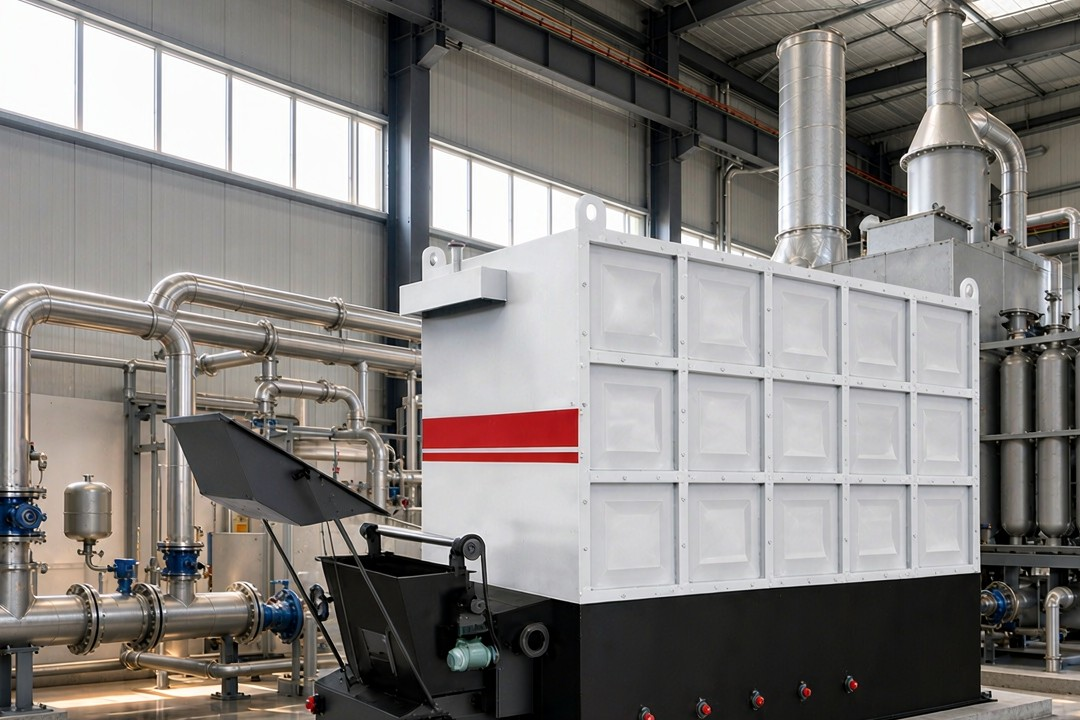
High-temperature process heat is one of the largest operating costs in a chemical plant. Reactors that must be held at 250 to 300 °C, reboilers that drive distillation columns around the clock, and dryers that run on long campaigns all need a heat source that is stable, clean at the point of use, and affordable per gigajoule delivered. A YLW biomass coal fired thermal fluid heater is designed for exactly this duty: a chain grate furnace that heats a closed loop of thermal oil up to 320 °C without pressurized steam, with a rated heat power ladder from roughly 1.4 MW to 7.0 MW (120 to 600 x 10,000 kcal/h). This guide explains where a YLW unit fits in chemical service, how to size one, how to plan the fuel supply, and what a practical maintenance program looks like.
Many chemical unit operations need heat carriers above 200 °C. Reaching those temperatures with steam would require saturated steam pressures well above 4 MPa, which means heavier pressure parts, licensed operators, and more demanding inspection regimes. A thermal fluid system reaches the same process temperatures at a working pressure of about 1.0 MPa on the heater side, because the oil loop itself is essentially unpressurized at the point of use and the fluid stays liquid rather than flashing to vapor.
Three practical benefits follow from this. First, temperature control is precise: the circulating pump holds a steady mass flow, and the outlet temperature modulates with the chain grate firing rate, so jacket temperatures on reactors can be held within a narrow band. Second, there is no blowdown, no condensate recovery, and no steam traps to maintain, which removes a whole category of losses common in steam plants. Third, when the heater burns biomass or coal instead of gas or fuel oil, the cost per unit of heat can drop substantially in regions where agricultural residues such as rice husk, corn cob, wood chips, or bagasse are available at stable prices.
In chemical service, a YLW heater normally feeds a distribution header that branches to several consumers. The table below shows common loads and the temperature windows where thermal oil is the natural carrier.
| Process consumer | Typical oil supply temperature | Share of total load | Notes |
|---|---|---|---|
| Reactor jackets and internal coils | 220 to 300 °C | 40 to 60 percent | Batch or continuous reaction heat, temperature held by control valve on each branch |
| Distillation and stripping reboilers | 240 to 320 °C | 20 to 35 percent | Steady continuous duty, good match for chain grate base load |
| Dryers, evaporators and flash vessels | 180 to 260 °C | 10 to 25 percent | Air heaters or oil-to-air exchangers fed from the same loop |
| Storage tank and pipeline heat tracing | 120 to 200 °C | 5 to 10 percent | Keeps viscous products such as resin or pitch pumpable |
Batch reactors often cycle between heating and holding. The circulating oil loop handles this well because each reactor branch has its own control valve and, where required, an oil-to-oil or oil-to-water cooler for the exothermic phase. Specifying the heater on the simultaneous peak demand, not the nameplate sum of all branches, avoids an oversized furnace that cycles too often.
Reboilers are steady consumers and are usually the first branch to be connected. Because their demand barely changes hour to hour, they set the base firing rate of the heater, and the batch branches modulate on top of that base load.
Where a plant dries salts, crystals, or filter cake, finned air heaters fed from the oil loop replace banks of electric heaters. Tank suction heaters and tracing loops can be added later as long as the total connected load still fits within the heater margin.
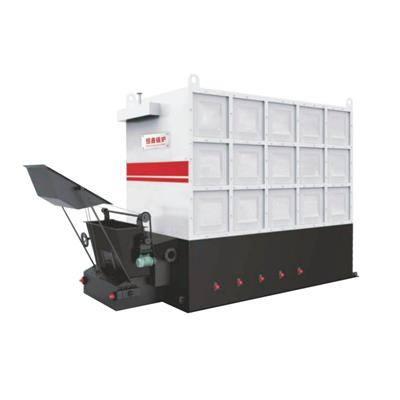
The YLW series is the large-capacity member of the Hengxin thermal fluid heater family. Key published parameters are summarized below.
| Parameter | Value |
|---|---|
| Rated heat power | 120 to 600 x 10,000 kcal/h (about 1.4 to 7.0 MW) |
| Rated working pressure | 1.0 MPa |
| Maximum working temperature | 320 °C |
| Design fuel | Biomass fuel, coal compatible |
| Combustion equipment | Chain grate stoker with coal/biomass spreader feeding |
| Heater body | Horizontal multi-pass coil arrangement, radiation and convection sections |
Hengxin Boiler holds ISO 9001 and ISO 14001 certification and a special equipment manufacturing license, and the company supports custom design where a client needs a non-standard capacity, an unusual fuel, or a specific layout.
A sizing exercise for chemical service can be kept short if it follows a fixed sequence.
| Step | What to do | Example value |
|---|---|---|
| 1. Add up process heat | List every consumer with its design duty and duty factor | Reboiler 2.2 MW, two reactors 1.5 MW peak combined, dryer 0.8 MW |
| 2. Apply simultaneity | Sum duties that truly overlap; stagger batch operations | Peak simultaneous load about 4.0 MW |
| 3. Add losses and margin | Include piping and flange losses plus 10 to 15 percent margin | About 4.5 MW required heater duty |
| 4. Select the model | Choose the nearest YLW rating above the result | YLW-350 or YLW-400 class, roughly 4.1 to 4.7 MW |
Two cautions deserve attention. Oil flow through the heater must stay within the range stated by the heater manufacturer, because low flow causes film temperature overheating even when the outlet temperature looks normal. And when several branches can shut at once, the design should confirm that the minimum flow the heater tolerates is still achievable through the remaining branches or a bypass.
The YLW furnace grate is designed for biomass fuel and remains compatible with coal. In many chemical clusters the practical fuel plan combines purchased biomass residues with a coal fallback, which protects production when biomass deliveries are short.
| Fuel | Typical net heating value | Handling notes |
|---|---|---|
| Wood chips and bark | about 12 to 14 MJ/kg | Needs covered storage and coarse screening before feeding |
| Rice husk, corn cob, agro pellets | about 13 to 16 MJ/kg | Light and bulky, fed by screw or spreader, watch for slagging at high ash |
| Bituminous coal | about 23 to 27 MJ/kg | Stable base fuel, size and ash content should be specified on purchase |
For planning purposes, a 4.5 MW heater at a thermal efficiency in the low eighties consumes on the order of one tonne per hour of good biomass, or roughly half that mass of coal. Actual figures depend on moisture content, ash, and operating pattern, so the fuel contract should be written around delivered energy rather than delivered tonnage wherever possible.
Buyers often compare the vertical YGL series with the horizontal YLW series. The simplest rule is capacity: YGL covers small duties from about 0.12 to 1.4 MW, while YLW starts where YGL ends and extends to about 7.0 MW. For a mid-size chemical plant with several reboilers and reactors, YLW is usually the correct class, and some sites install one YLW for the continuous base load plus a smaller YGL for standby or low-season duty.
Solid fuel firing raises flue gas treatment questions early, and it should. A chemical plant application normally includes a multi-cyclone or fabric filter dust collector, and depending on local limits it may add a desulfurization stage for coal firing and low-NOx combustion measures such as staged air on the grate. Stack monitoring, fuel ash analysis, and ash disposal routes belong in the project plan from day one, because permits are granted around the whole fuel cycle rather than the heater alone. Hengxin can advise on the configuration that matches the local emission limits during the quotation stage.
| Item | Typical requirement |
|---|---|
| Heater foundation | Reinforced concrete plinth level within a few millimeters, grouted before setting the body |
| Oil circulation pumps | Duty plus standby, sized for the heater minimum and maximum flow window |
| Expansion tank | Sized above the total oil volume, positioned higher than the highest user |
| Piping | Carbon steel, slope for drainage, flushing connections installed before first fill |
| Dust collector and stack | Matched to local emission limits, access platforms for maintenance |
| Controls | Outlet temperature control tied to grate speed and draft, low-flow interlock tested before firing |
Commissioning should end with a documented test of the low-flow trip, the flame-out and draft interlocks, and a slow initial oil heat-up that drives off moisture without pushing film temperatures past the fluid limit.
| Frequency | Task |
|---|---|
| Daily | Log outlet and return temperatures, pump pressure, grate and fuel feed condition |
| Weekly | Check oil level and color in the expansion tank, clean grate ash, inspect refractory doors |
| Monthly | Sample thermal oil for acid number and viscosity trend, verify safety valve and instruments |
| Annually | Internal coil inspection, refractory repair, grate drive overhaul, dust collector service |
Thermal oil ages faster when film temperatures run high, so the single most valuable habit is keeping flow where it belongs and resisting the urge to raise outlet temperature beyond what the process really needs.
Yes. The furnace and chain grate are designed for biomass fuel and remain coal compatible. Many plants keep a coal stock as backup fuel so production continues when biomass supply is tight. Fuel switching should stay within the fuel analysis range agreed with the manufacturer.
A synthetic thermal fluid rated for at least 330 to 340 °C bulk temperature is normally selected so that a margin remains between operating and maximum film temperature. The fluid supplier data sheet, not the process temperature alone, should decide the grade.
A YLW class heater with its chain grate, dust collector, pumps and expansion tank typically fits within a compact outdoor or light-structure bay, but exact dimensions depend on capacity and layout. Hengxin provides arrangement drawings with the quotation so civil works can be planned in parallel with manufacturing.
Yes. Beyond the standard range, Hengxin supports design and manufacture to client drawings and requirements, supported by ISO 9001 and ISO 14001 certified production and a special equipment manufacturing license.
If your chemical plant needs stable heat between 200 and 320 °C and wants to cut fuel cost with biomass or coal, the YLW series deserves a place on the shortlist. Send your process duty list, fuel analysis, and site layout through the contact page of Hengxin Boiler, and the engineering team will return a sizing proposal, price, and delivery schedule. You can also review the full range of chemical industry boiler applications to see how other plants combine steam and thermal fluid systems on one site.