
Company News
Amino acid fermentation is measured in grams per litre, but it is paid for in tonnes of steam. Every batch opens with a sterilisation cycle that has to reach 121 degrees Celsius and hold there, the broth is then concentrated through a multi effect evaporator, and the finished lysine, threonine or monosodium glutamate leaves through a dryer heated by steam coils. When the header sags for two minutes in the middle of sterilisation, the batch is rejected, and that loss is far larger than any saving from an undersized boiler.
This article examines the steam duty of a mid sized amino acid fermentation plant, explains why the load profile is so peaky, and shows how an NWNS integrated condensing boiler is sized and specified for it. The worked example uses two 100 cubic metre fermenters handling about 120 tonnes of broth per day, a scale common among specialty amino acid, organic acid and enzyme producers that buy gas rather than burn coal.
Before any boiler discussion, the heat users have to be listed honestly. Fermentation plants hide more consumers than the process flow diagram suggests, and the usual cause of a disappointing installation is a forgotten consumer rather than an arithmetic error.
| Steam user | Working conditions | Load character | What a shortfall costs |
|---|---|---|---|
| Continuous media steriliser, ejector or jet type | Steam 0.35 to 0.5 MPa, medium heated to 140 to 145 degrees Celsius, 30 to 60 seconds hold | Sharp peak, 0.20 to 0.25 kg steam per kg medium | Hold temperature drops below set point, medium is under sterilised, contamination risk |
| Fermenter sterilisation in place | Vessel and piping at 121 to 125 degrees Celsius for 30 to 45 minutes, 0.1 to 0.2 MPa gauge | Batch, 1.5 to 2.0 tonnes per 100 cubic metre vessel | Cycle extended, production delayed, dead legs survive |
| Seed fermenters, shake flask and lab autoclaves | 121 degrees Celsius, small volumes | Short batch, frequent | Seed train breaks, whole downstream schedule slips |
| Multi effect evaporator, three or four effects | First effect 0.25 to 0.4 MPa, later effects under vacuum at 0.06 to 0.15 MPa | Continuous, dominant base load | Broth sits longer, colour and assay degrade |
| Crystallisers and vacuum pans | 0.15 to 0.3 MPa, jacket heating | Steady, moderate | Poor crystal habit, more fines in the centrifuge |
| Dryer air heaters, spray or fluid bed | Coils at 0.8 MPa, air 130 to 180 degrees Celsius | Continuous, second largest base load | Product above moisture specification, caking in bags |
| Ion exchange regeneration and CIP hot water | Hot water 60 to 80 degrees Celsius | Day shift, intermittent | Resin capacity loss, longer rinse cycles |
| Deaerator and workshop heating | Deaerator 0.02 to 0.05 MPa, heating seasonal | Continuous small plus seasonal | Oxygen corrosion, cold work areas |
Read the table as two groups. The evaporator, the dryer, crystallisation and the deaerator run whenever the plant runs, so they form a flat base that the boiler must carry hour after hour. Sterilisation, by contrast, arrives in blocks: a continuous steriliser pulls its steam in fifteen to forty minutes, a fermenter sterilisation in forty five, and both of them want the header at pressure from the first minute.
A boiler chosen on the daily average will fail on the peak, and a boiler chosen on the sum of every connected user will run at 40 percent for most of the year and condense poorly. The two loads have to be handled separately, then recombined.
| Property | Base load, evaporation and drying | Peak, sterilisation |
|---|---|---|
| Duration | 20 to 24 hours per day, 300 days and more | 30 to 60 minutes, several times per shift |
| Share of steam | 50 to 60 percent of annual steam | Small in energy, decisive in capacity |
| Response needed | Slow, steady modulation | Full output within two to three minutes |
| Sensitivity | Efficiency, fouling, turndown | Pressure stability, steam dryness |
| Consequence of failure | Higher fuel bill, off specification colour | Rejected batch, lost seed train, cleaning and restart |
Two physical details explain why sterilisation is so unforgiving. First, saturated steam temperature is tied to pressure: 0.1 MPa gauge gives about 121 degrees Celsius, 0.2 MPa gives 133, and 0.35 MPa gives 145. A pressure dip of 0.05 MPa at the steriliser means a drop of roughly five to six degrees, enough to leave the coldest part of the vessel below the hold temperature. Second, a continuous steriliser meters steam directly into the medium, so wet steam does two kinds of damage at once: the water fraction dilutes the medium and the temperature controller hunts as the steam quality wanders.
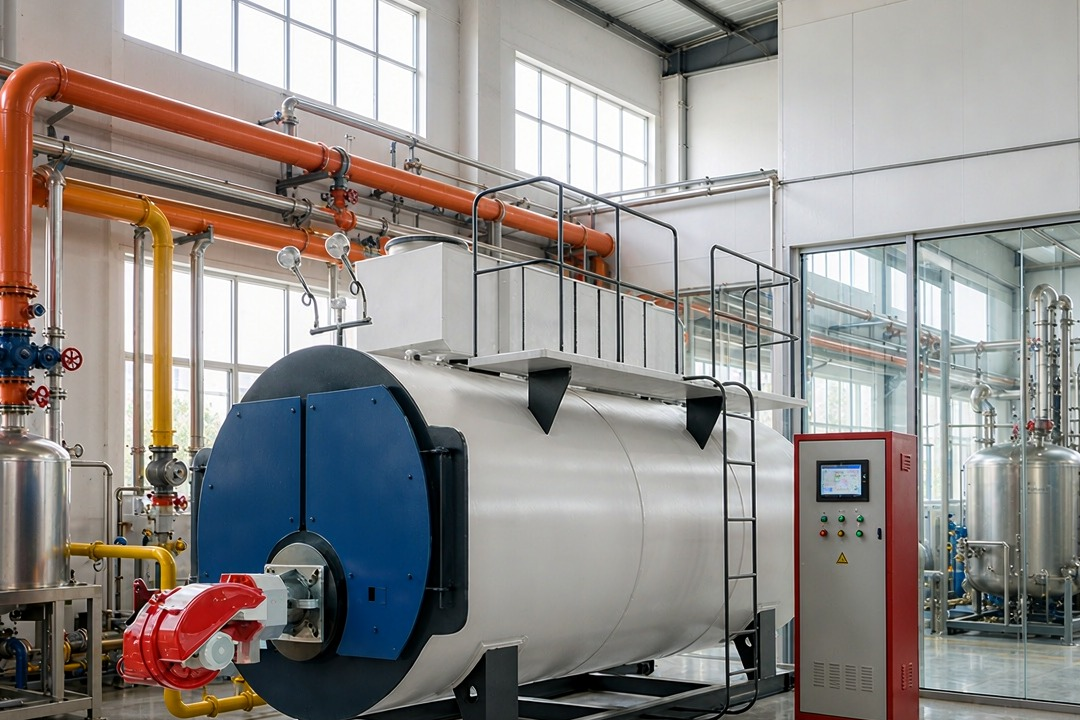
The NWNS is a horizontal three pass fire tube boiler with a full wet back reversal chamber and a condenser integrated into the same package. Feed water passes the condenser, the economiser duty is performed inside the package, and the flue gas leaves at 60 to 80 degrees Celsius. Published thermal efficiency is above 100.2 percent on a lower heating value basis, a figure that only makes sense once the latent heat of the water vapour in the flue gas is recovered.
Most fermentation plants return 70 to 80 percent of their condensate at 90 to 95 degrees Celsius, and this is where many condensing claims collapse. An economiser cooled by feed water at 95 degrees Celsius cannot take flue gas below about 105 degrees, so the water vapour never condenses and the second decimal of efficiency never appears. The NWNS solves the problem by cooling the flue gas against cold make up water in the integrated condenser, heating it from roughly 20 degrees to 60 or 70 before it reaches the deaerator. The flue gas is therefore cooled below the 55 to 57 degree dew point of natural gas, the latent heat is captured, and the hot condensate return does not interfere. The condenser drains are stainless, so the acidic condensate is handled without shortening the life of the shell.
Fire tube boilers carry a large body of water around a corrugated furnace, and that stored energy is exactly what a sterilisation peak needs. When a continuous steriliser opens its control valve, the shell releases steam immediately while the burner ramps, so header pressure dips by a fraction of a bar rather than collapsing. The corrugated furnace and threaded flue tubes raise gas side heat transfer, which keeps the recovery fast, and the wet back reversal chamber removes the refractory rear wall that used to be the first thing to fail after years of cycling.
The package arrives with boiler body, burner, integrated condenser, water tank, feed pump, steam header, deaerator, softener and control panel on a single frame. For a fermentation project this compresses the mechanical schedule: one foundation, one gas connection, one flue, one electrical feed, and a single supplier answering for the whole chain. Plants built in phases can add a second unit later without redesigning the boiler house.
Gas firing produces no soot and no ash, which matters when the boiler house sits within thirty metres of a fermentation hall with filtered air intakes. A modulating burner with oxygen trim keeps the excess air band tight, the explosion relief door protects the furnace in the unlikely event of a gas train fault, and the LCD panel shows the operating conditions that the shift team actually needs: pressure, level, flue temperature and alarm history.
The steam in an amino acid plant touches two very different things: the outside of jackets and coils, and, in some designs, the medium itself. The two cases need different answers and the boiler house has to be designed around the difference.
NWNS supplies plant steam, treated with soft water and boiler chemicals. That steam is suitable for jackets, reboilers, air heater coils, vacuum pans and the steam side of a clean steam generator. Where steam is injected directly into medium, as in a jet steriliser or a sparger, a separate 316L clean steam generator fed with reverse osmosis water should be installed downstream. The capital cost is modest and the alternative, carrying boiler treatment chemicals into a fermentation broth, is a quality assurance problem that cannot be argued away.
| Parameter | Target | Reason |
|---|---|---|
| Make up water hardness | 0.03 mmol/L or lower | Scale on the furnace crown is the main cause of tube overheating |
| Boiler water pH at 25 degrees Celsius | 10 to 12 | Protects the steel from corrosion while staying inside the treatment programme |
| Total dissolved solids | 3,500 mg/L or lower | Controls carryover and keeps steam dry at the steriliser |
| Dissolved oxygen after deaerator | 0.05 mg/L or lower | Prevents pitting in the shell and the condenser |
| Iron and copper | 0.3 mg/L and 0.05 mg/L or lower | Marks active corrosion before it reaches the tubes |
| Oil and organic contamination | 2 mg/L or lower | Foaming and carryover, often traced to a leaking jacket |
Volatile amines are excellent for condensate line protection in a power plant and unacceptable where steam may contact product. The treatment programme for a fermentation site should use chemicals cleared for food contact service, with the supplier documentation filed alongside the batch records. The same discipline applies to the condensate: evaporator vapour condensate carries an organic load measured in thousands of milligrams per litre of COD and must go to the effluent plant, not to the deaerator. Only clean condensate from jackets, coils and the steriliser shell should return to the boiler.
Ten ratings span 1 to 20 tonnes per hour, all built on the same wet back platform with the integrated condenser. Pressure is available from 0.7 to 2.5 MPa, giving saturated steam from 171 to 225 degrees Celsius, and the burner is configured for natural gas, light oil, heavy oil or a dual fuel combination. The table below reproduces the published transport weights and dimensions, which is what the project team needs for the foundation and the crane lift.
| Model | Capacity (t/h) | Max transport weight (kg) | Transport size L x W x H (mm) |
|---|---|---|---|
| NWNS1-1.25-YQ | 1 | 4,800 | 3,400 x 1,900 x 2,200 |
| NWNS2-1.25-YQ | 2 | 7,500 | 4,073 x 2,000 x 2,450 |
| NWNS3-1.25-YQ | 3 | 9,000 | 4,550 x 2,000 x 3,450 |
| NWNS4-1.25-YQ | 4 | 12,000 | 5,200 x 2,300 x 3,300 |
| NWNS6-1.25-YQ | 6 | 15,198 | 4,900 x 2,938 x 3,605 |
| NWNS8-1.25-YQ | 8 | 19,000 | 6,330 x 2,910 x 3,150 |
| NWNS10-1.25-YQ | 10 | 24,372 | 6,860 x 2,808 x 3,168 |
| NWNS12-1.25-YQ | 12 | 27,500 | 7,100 x 3,000 x 3,200 |
| NWNS15-1.25-YQ | 15 | 30,000 | 7,365 x 3,200 x 3,508 |
| NWNS20-1.25-YQ | 20 | 39,000 | 7,800 x 3,650 x 3,960 |
For fermentation duty the practical band is 6 to 15 tonnes per hour. Below 6 tonnes the evaporator and dryer of a modern plant rarely fit, and above 15 tonnes the capital and the footprint usually point to a water tube design instead. A plant that needs 20 tonnes for a single evaporator train should compare the NWNS20 against an SZS water tube unit before committing, because the two have different part load behaviour.
Start with the continuous users. The evaporator removes about 88 tonnes of water per day from 120 tonnes of broth at 12 percent solids, concentrating it to 45 percent. A triple effect set with a steam economy of 2.8 kilograms of water per kilogram of steam needs roughly 31 tonnes of steam per day, which is 1.6 tonnes per hour across a 20 hour campaign. The dryer removes about 17 tonnes of water per day and, with air heating at 1.5 kilograms of steam per kilogram of water, adds 1.3 tonnes per hour. Crystallisation takes 0.7, ion exchange and CIP 0.6, and the deaerator with winter heating 0.5. The base is therefore 4.7 tonnes per hour and it runs all year.
One continuous steriliser treating 45 tonnes of medium per batch at 0.22 kilograms of steam per kilogram consumes about 10 tonnes of steam in four hours, which is 2.5 tonnes per hour while it runs. A fermenter sterilisation of a 100 cubic metre vessel takes 1.7 tonnes spread over forty five minutes, and the seed and lab sterilizers add 0.5. The connected peak is 4.7 tonnes on top of the base.
Sterilisation cycles are scheduled, but they are not perfectly spaced, and a delayed batch will overlap the next. A simultaneity factor of 0.85 on the peak group is realistic. Base 4.7 plus 4.7 times 0.85 gives 8.7 tonnes per hour, and a 10 percent margin for fouled coils, cold make up in winter and the next debottleneck gives a design output of 9.6 tonnes per hour.
A single 10 tonne unit would sit at 96 percent of design, leaving nothing for the day a steriliser is opened early, and no ability to service the boiler during a campaign. The comparison below uses the same 9.6 tonne design load.
| Item | Basis | Result |
|---|---|---|
| Evaporator | 31 t/day steam, 20 h | 1.6 t/h |
| Dryer air heaters | 17 t/day water, 1.5 kg steam per kg water | 1.3 t/h |
| Crystallisers, ion exchange, CIP, deaerator, heating | Winter design | 1.8 t/h |
| Base load | 4.7 t/h | |
| Continuous steriliser, fermenter sterilisation, seed | 2.5 plus 1.7 plus 0.5 | 4.7 t/h |
| Peak at 0.85 simultaneity | 4.7 x 0.85 | 4.0 t/h |
| Design load with 10 percent margin | (4.7 plus 4.0) x 1.10 | 9.6 t/h |
| Scheme | Capacity | Load at peak | If one unit stops | Verdict |
|---|---|---|---|---|
| A: one NWNS10-1.25-YQ | 10 t/h | 96 percent | No steam at all | Rejected, no margin and no standby |
| B: one NWNS12-1.25-YQ | 12 t/h | 80 percent | No steam at all | Workable, but a boiler service stops the plant |
| C: NWNS8 plus NWNS4 | 12 t/h | 80 percent each | 8 t/h, base plus one steriliser | Selected, redundancy at modest cost |
| D: two NWNS6-1.25-YQ | 12 t/h | 80 percent each | 6 t/h, evaporation must be curtailed | Alternative where the layout is tight |
Scheme C is the one most fermentation plants settle on. The NWNS8 carries the base and the NWNS4 follows the sterilisation blocks, and either unit can be isolated for inspection while the other keeps the campaign alive. The header runs at 1.25 MPa with pressure reducing stations at 0.8 MPa for dryer coils, 0.4 MPa for the continuous steriliser and 0.2 MPa for vessel sterilisation, so each user sees a stable pressure rather than the boiler pressure.
At a design load of 9.6 tonnes per hour and an average of 6 tonnes per hour over 6,000 operating hours, the plant buys about 36,000 tonnes of steam a year. The figures below assume the condensing package working as intended, with flue gas leaving at 60 to 80 degrees Celsius.
| Fuel | Per tonne of steam | Annual at 36,000 t | Note |
|---|---|---|---|
| Natural gas | 72 to 75 Nm3 | 2.6 to 2.7 million Nm3 | Lowest maintenance, cleanest flue gas |
| LPG | 56 to 59 kg | 2,020 to 2,120 t | Sites without a pipeline |
| Light diesel | 58 to 61 kg | 2,090 to 2,200 t | Dual fuel backup during curtailment |
| Heavy fuel oil | 61 to 64 kg | 2,200 to 2,300 t | Requires preheating and atomising steam |
Condensate return is the cheapest efficiency measure in the plant and the one most often neglected. Raising the feed water from 20 degrees with all make up to a mix of 76 degrees with 75 percent condensate at 95 degrees cuts the heat input per tonne of steam by close to 9 percent, because the boiler no longer has to heat cold water from ambient. The return line pays for itself in a single season, provided the contamination rule is respected: clean condensate only, with a conductivity meter on the return header and an automatic dump valve to the effluent sump.
The package is compact, but a fire tube boiler still needs room at the rear for tube work and at the front for the burner and its gas train. The checklist below covers what the site team should confirm before the foundation is poured.
| Item | Requirement | Why it matters |
|---|---|---|
| Foundation and house | Level plinth, 1.5 m at burner side, 2 m at rear door, roof height for the lift | Tube replacement and burner service without dismantling the house |
| Flue and chimney | Insulated flue, drain at the base, sampling port, height per local rules | Keeps flue gas above dew point upstream of the condenser and allows testing |
| Gas train | Filter, regulator, double shutoff valves, leak test, low pressure switch | Stable burner pressure through sterilisation spikes |
| Feed water | Softener, deaerator, dosing pumps, sample cooler | Hardness control and oxygen removal, the two determinants of tube life |
| Blowdown | Continuous and intermittent blowdown to a flash vessel | TDS control without dumping energy to drain |
| Steam header | Separator at the boiler outlet, reducing stations, traps at every low point | Dry steam at the steriliser and no water hammer |
| Condensate | Return header with conductivity monitoring and dump valve | Protects the boiler from organic contamination |
| Commissioning | Hydraulic test, interlock test, 8 hour load run, efficiency measurement | Confirms the guaranteed figures before the campaign starts |
| Interval | Task | Reason |
|---|---|---|
| Every shift | Blowdown, water level and pressure check, flame observation | Catches carryover and level faults early |
| Daily | Water hardness and alkalinity test, flue gas temperature log | A rising flue temperature points to scale or a dirty condenser |
| Weekly | Manual lift of safety valves, trap survey, gas train leak check | Safety valves seize when left alone |
| Monthly | Burner electrodes and flame scanner, filter cleaning, control calibration | Prevents nuisance lockouts during a sterilisation cycle |
| Quarterly | Flue gas analysis, condenser inspection, water side inspection through handholes | Keeps efficiency inside the guarantee |
| Annually | Internal and external inspection, safety valve calibration, efficiency re-test | Statutory requirement and a baseline for the next year |
| Mistake | What happens | Correct approach |
|---|---|---|
| Sizing on average steam demand | Pressure collapses at the first sterilisation, batch lost | Size on base plus peak with a simultaneity factor, then add margin |
| Ignoring steam dryness at the steriliser | Medium dilution and temperature hunting | Separator at the boiler, correct slopes, traps and strainers |
| Returning evaporator condensate to the boiler | Foaming, carryover, organic contamination of the whole system | Return clean condensate only, monitor conductivity, dump the rest |
| Using amine based treatment | Product contact risk, quality audit failure | Food contact approved programme, clean steam generator for injection |
| No standby and no load shedding plan | A boiler service stops fermentation for days | Two units, or a documented priority list that protects sterilisation |
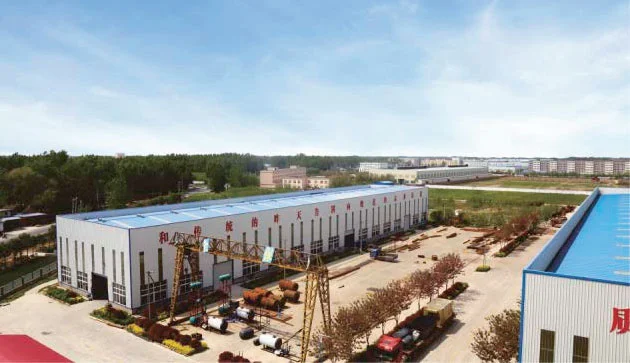
Henan Hengxin Boiler Co., Ltd. manufactures the NWNS range at its Taikang works in Zhoukou, Henan, and holds ISO 9001 and ISO 14001 certification, a special equipment manufacturing licence and 3A credit rating, with the certificates listed on the honor page. For fermentation projects the engineering team works from the process data sheet rather than a catalogue: steam demand profile, pressure levels, fuel analysis, altitude, ambient conditions and the available footprint all feed into the proposal. Custom drawings, non standard pressure ratings, dual fuel burners, extended skids and OEM supply under the customer brand are all routine, and the chemical industry application page shows comparable installations.
Documentation for a project of this kind normally includes the general arrangement drawing, foundation loading, gas train schematic, electrical interface list, commissioning procedure and the operating manual, issued in English and, where required, in the language of the end user. Spare parts recommendations cover the first two years and are quoted with the boiler so that the maintenance budget is known before the order is placed.
For two 100 cubic metre fermenters with 120 tonnes of broth per day, the base load is about 4.7 tonnes per hour and the design load after peak and margin is 9.6 tonnes per hour, which is met by an NWNS8 plus an NWNS4 or a single NWNS12. Plants with a larger evaporator or a spray dryer instead of a fluid bed dryer should expect 1.5 to 2 tonnes per hour more for each additional tonne of water evaporated per hour.
Plant steam should not be injected directly. Use it for jackets, coils, reboilers and the steam side of a clean steam generator, and inject 316L clean steam produced from reverse osmosis water. This keeps boiler treatment chemicals out of the broth and satisfies the documentation that quality assurance will ask for during an audit.
The integrated condenser is cooled by cold make up water rather than by the hot condensate return. Make up enters at around 20 degrees, leaves the condenser at 60 to 70 and then passes to the deaerator, so the flue gas can be cooled to 60 to 80 degrees, below the 55 to 57 degree dew point of natural gas. That is how the published efficiency above 100.2 percent on a lower heating value basis is reached in real operation, not only on a test stand.
Most fermentation plants run the boiler at 1.25 MPa and reduce downstream: 0.8 MPa for dryer coils, 0.35 to 0.4 MPa for a continuous steriliser and 0.1 to 0.2 MPa for vessel sterilisation. Running the boiler higher than the highest user needs adds nothing but loss, while running it too low removes the margin that keeps sterilisation temperature stable.
Steam is the second raw material in an amino acid plant, and it is the only one that can be lost in a two minute pressure dip. A correctly sized condensing boiler with genuine redundancy protects the campaign, while the integrated condenser and a disciplined condensate return keep the fuel bill where the feasibility study assumed it would be. Send the broth volume, the sterilisation schedule and the evaporation duty to the Hengxin application team and the reply will include a load calculation, a model recommendation, a layout drawing and the fuel figures for the local gas price.