
Company News
Steam is the working fluid of a modern textile plant. Scouring, dyeing, printing, drying, heat setting and finishing all consume process steam at pressures and flow rates that change hour by hour. When the steam supply fluctuates, shade variation, wet-dry unevenness and rework follow. This is why the WNS gas boiler has become one of the most widely specified steam generators in textile clusters across Asia, Africa and the Middle East: it responds quickly to load changes, runs on the natural gas that is now available to most industrial parks, and is compact enough to sit close to the dyeing floor.
This guide explains how the WNS gas boiler works, how to match its capacity to textile process loads, what the key technical specifications mean, and how to compare it with other steam boiler options before you place an order. It is written for purchasing managers, plant engineers and project consultants who need practical selection data rather than marketing language.
A dyeing and finishing line is a chain of batch and continuous processes, each with its own steam demand profile. Jet dyeing machines call for large volumes of steam during the heating ramp, then drop to a holding load. Stenter frames and cylinder dryers draw steam continuously and are sensitive to pressure drops. Printing and curing units need medium pressure steam at a steady rate. Because these loads overlap unpredictably, a boiler that cannot follow the load will force the plant to buffer with an oversized steam header or accept quality losses.
A well selected WNS gas boiler solves this by combining a large steam space, a responsive burner and a control system that modulates output to match live demand. The result is a stable header pressure, drier steam and fewer rejected batches. You can review the full WNS range on our WNS gas boiler product page, and see how steam is used across different sectors on the boiler applications page.
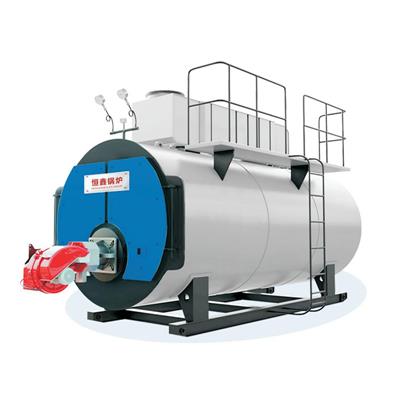
WNS is the standard Chinese classification for a horizontal, fire-tube, wet-back steam boiler with a packaged shell. In practical terms it is a complete steam plant delivered as a single unit: pressure vessel, burner, feedwater system, safety valves, controls and insulation are assembled, tested and shipped together. That makes site work fast and predictable compared with a field-erected water-tube boiler.
Combustion gases travel through the furnace, return through the second-pass tube bundle and then pass through a third bundle before leaving the boiler. The wet-back reversal chamber is fully surrounded by water, which eliminates the refractory-lined dry-back arrangement that causes hot spots and maintenance downtime. Because the whole gas path is inside the water volume, heat transfer is efficient and the outer shell stays cool, reducing radiation losses and improving operator safety.
The WNS gas boiler is designed for gaseous and liquid fuels. The standard configuration runs on natural gas, and the same shell can be matched with burners for light oil or heavy oil. Dual-fuel burners allow a plant to switch between gas and oil according to price or supply availability, which is a common requirement in regions where gas supply is seasonal. Low nitrogen oxide burners are available where local emission limits apply.
Modern WNS units ship with programmable logic controller based control panels, flame monitoring, pressure and level protection, and optional remote monitoring. The burner modulates between low and high fire to follow the steam demand, and the boiler can be switched to automatic operation with a single command. For a textile plant running three shifts, this reduces the dependence on a dedicated boiler operator while keeping safety interlocks active.
Capacity selection starts with a process audit, not with a rule of thumb. The table below shows typical steam demand patterns for common textile operations. Actual figures must be confirmed with the equipment suppliers, because machine size, fabric weight and production speed all change the load.
| Textile Process | Typical Steam Role | Load Behaviour | Selection Note |
|---|---|---|---|
| Sizing and desizing | Heating wash water and drying size film | Moderate, continuous | Count peak when several lines start together |
| Scouring and bleaching | Heating chemical baths to 95-100 C | High ramp, then holding | Ramp rate sets minimum boiler size |
| Jet and beam dyeing | Heating dye liquor and maintaining temperature | Cyclic, batch driven | Steam space matters more than steady output |
| Printing and curing | Medium pressure steam for dryers and curing | Steady during a run | Pressure stability protects colour repeatability |
| Stenter and cylinder drying | Continuous steam for fabric drying | High and continuous | Largest single consumer in most mills |
| Heat setting | High temperature steam and thermal fluid | High burst demand | Check whether steam or thermal fluid is used |
| Finishing and calendering | Steam for rollers and conditioning | Low and steady | Often served by the spare capacity margin |
A practical approach is to sum the simultaneous steam demand of all equipment, add a margin for distribution losses, condensate return inefficiency and future expansion, and then choose the nearest standard boiler size above that total. Where the plant runs several dyeing lines with offset batch schedules, a single larger WNS boiler with good modulation is usually more economical than several small units, because it avoids duplication of burners and control systems.
The table below lists the standard specification envelope for the Hengxin WNS gas boiler. Capacities outside these ranges and higher pressure ratings can be engineered to order, and custom shells are available when a project has special space or fuel constraints.
| Parameter | Range | Notes |
|---|---|---|
| Rated steam capacity | 1-20 t/h | Standard models across the range |
| Rated working pressure | 1.0-2.5 MPa | Select according to process and pipeline losses |
| Saturated steam temperature | 184-225 C | Follows working pressure |
| Design fuel | Natural gas, light oil, heavy oil | Dual-fuel burners available |
| Structure | Horizontal fire-tube, three pass, wet-back | Packaged, skid mounted |
| Control | PLC with flame and pressure protection | Modulating burner, remote monitoring optional |
| Efficiency | High, with economizer option | Further gains from condensate return and heat recovery |
The pressure you select should be the lowest value that still delivers the required temperature at the furthest point of use. Oversizing pressure increases flash losses and standing losses without improving process performance. For most textile dyeing duties, a working pressure in the lower half of the range is sufficient, while printing and heat setting lines may need the higher end.
Fuel is the dominant operating cost of any steam plant, so efficiency decisions made at selection time stay with the plant for its whole service life. Three factors matter most. First, the boiler itself should transfer as much heat as possible from the flue gas to the water, which is why economizers and, where justified, air preheaters are worth considering. Second, condensate return should be maximised, because every litre of returned hot condensate is water and heat that does not have to be purchased again. Third, combustion tuning should be repeated regularly, since a burner that drifts out of adjustment quietly wastes fuel.
For a textile mill, the practical efficiency programme is straightforward: operate the WNS boiler near its design load rather than at very low fire for long periods, insulate steam and condensate lines, repair steam traps promptly, and recover flash steam from high pressure condensate. These measures are inexpensive compared with boiler replacement and often deliver the fastest payback.
Textile plants sometimes consider alternative boiler types. The comparison below sets out how the WNS design differs from common alternatives so that the trade-offs are explicit.
| Boiler Type | Best Fit | Relative Advantage | Relative Limitation |
|---|---|---|---|
| WNS gas boiler | Low to medium pressure process steam, 1-20 t/h | Fast response, packaged, gas and oil capable | Capacity ceiling for very large plants |
| Oil/gas atmospheric hot water boiler | Hot water heating and bathing loads | Simple, no pressure vessel duty | Not a steam source |
| SZS oil/gas fired boiler | Large steam demand, higher pressure | High capacity and efficiency | Field erection, larger footprint |
| Biomass fired steam boiler | Plants with cheap local biomass | Low fuel cost where biomass is abundant | Fuel handling, ash and labour |
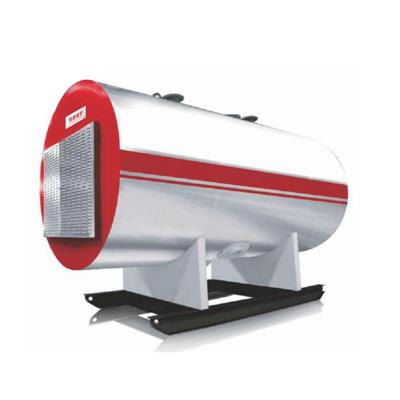
| Electric heating boiler | Small loads, strict emission limits | Clean, compact, simple | Higher running cost per tonne of steam |
Because the WNS gas boiler arrives packaged, installation focuses on foundations, gas train connection, feedwater and blowdown piping, flue routing and electrical integration. The boiler room should have adequate ventilation, a gas detection arrangement where required by local code, and clear access for inspection and tube cleaning. Commissioning includes pressure testing, safety valve setting, burner adjustment and a full load trial.
Safety devices on WNS units typically include pressure controllers and limit switches, water level protection with alarms and lockouts, flame failure protection with automatic fuel shut-off and purge cycles, and relief valves sized for the maximum firing rate. Compliance requirements vary by country, so the design pressure, inspection certificates and material documentation should be confirmed against the local boiler and pressure vessel regulations before shipment.
The following checklist helps purchasing teams compare offers on equal terms rather than on headline price alone.
Confirmed steam demand in t/h, including simultaneous peaks and a defined expansion margin.
Working pressure and required steam temperature at the point of use.
Fuel type, supply pressure and whether dual-fuel capability is needed.
Efficiency guarantee and the heat recovery equipment included in the scope.
Burner brand and the availability of local service and spare parts.
Control system scope, including remote monitoring and data logging.
Scope split: foundations, gas train, flue, water treatment and electrical work.
Pressure vessel certification, material certificates and inspection reports.
Delivery schedule, installation supervision and operator training.
Warranty terms and the response time for after-sales support.
A supplier that can discuss your dyeing schedule, condensate return rate and load profile in detail is usually a better partner than one that quotes only a tonnage. If you would like help sizing a unit for a specific mill, please contact our engineers with your process list and we will prepare a selection proposal.
It depends on the number and type of machines rather than on floor area. A typical mid-sized dyeing and finishing plant with stenter drying often falls in the 6 to 15 t/h range, while smaller beam or package dyeing houses can be served by 2 to 4 t/h. The correct figure comes from adding the simultaneous steam demand of all equipment and adding a margin for losses and growth.
Yes. The shell is compatible with gaseous and liquid fuels, and a dual-fuel burner allows switching between natural gas, light oil and heavy oil. This is useful where gas supply is interrupted seasonally or where fuel price differentials change during the year.
Start-up time depends on the size of the unit, the water volume and the burner output. A packaged fire-tube boiler typically reaches working pressure in a short period compared with a large field-erected water-tube boiler, which suits textile plants that need steam early in the first shift. Exact figures should be requested from the manufacturer for the model under consideration.
Partly. Because the range extends to 20 t/h, a plant can often step up within the same design family. Where growth beyond that range is expected, it is worth discussing a modular arrangement of two units with a common header, so that the plant retains modulation flexibility and standby capability.
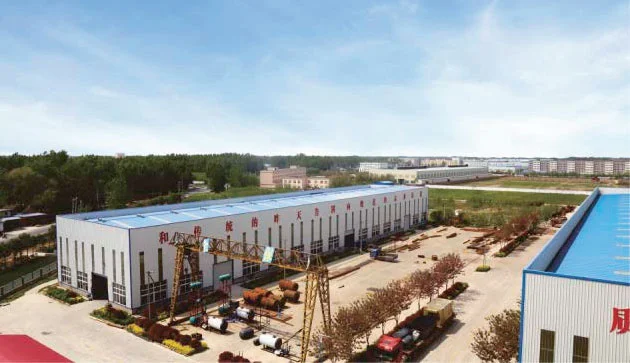
Henan Hengxin Boiler Co., Ltd. designs and manufactures the WNS gas boiler and a complete family of industrial steam, hot water and thermal fluid boilers, including electric heating boilers, biomass fired units and packaged hot air furnaces. Custom engineering is available for projects with unusual space, fuel or pressure requirements.
If you are planning a new boiler house or replacing ageing steam capacity, share your process list, fuel data and site conditions with us. Our team will recommend a model, prepare a technical proposal and support you through installation and commissioning. Visit the contact page to send your enquiry and receive a detailed reply.